
Mass Coral Bleaching

Coral bleaching is a major stress response of corals, causing them to expel their symbiont algae, turn white, and sometimes die. By 2050, 90% of coral reefs are expected to experience coral bleaching annually.
Mass bleaching events refer to observations of bleached corals spanning hundreds or even thousands of kilometers, thereby affecting entire ecosystems. The frequency and severity of mass bleaching events have been increasing over the last few decades, causing reef degradation at a global scale.
Over the last 30 years, four global-scale coral bleaching events have occurred in 1997-1998, 2009-2010, 2014-2017, and 2023-2025 (as reported by Hughes et al. in 2018, Spady et al. 2026). ref In April 2024, the National Oceanic and Atmospheric Administration (NOAA) and International Coral Reef Initiative (ICRI) declared that the 4th global mass bleaching event was unfolding with bleaching recorded in at least 53 countries since February 2023, ref in concert with the ongoing El Niño. As of December 2025, global coral reefs have experienced an unprecedented extent and intensity of bleaching-level heat stress, including 99.9% of reefs in the Caribbean and greater Atlantic Ocean. ref There have now been confirmations of mass bleaching in 84 countries since 2023.
Strong El Niño events have been correlated with widespread global coral bleaching in the past. ref However, average global SSTs during La Niña and ENSO-neutral phases are now on par with what were considered anomalous extremes 25 years ago, meaning periodic warming mechanisms like El Niño may no longer be a prerequisite for global-scale bleaching stress. ref Despite this, there is still an expectation of more severe and prolonged marine heatwave events, and associated bleaching, during El Niño phases of ENSO.
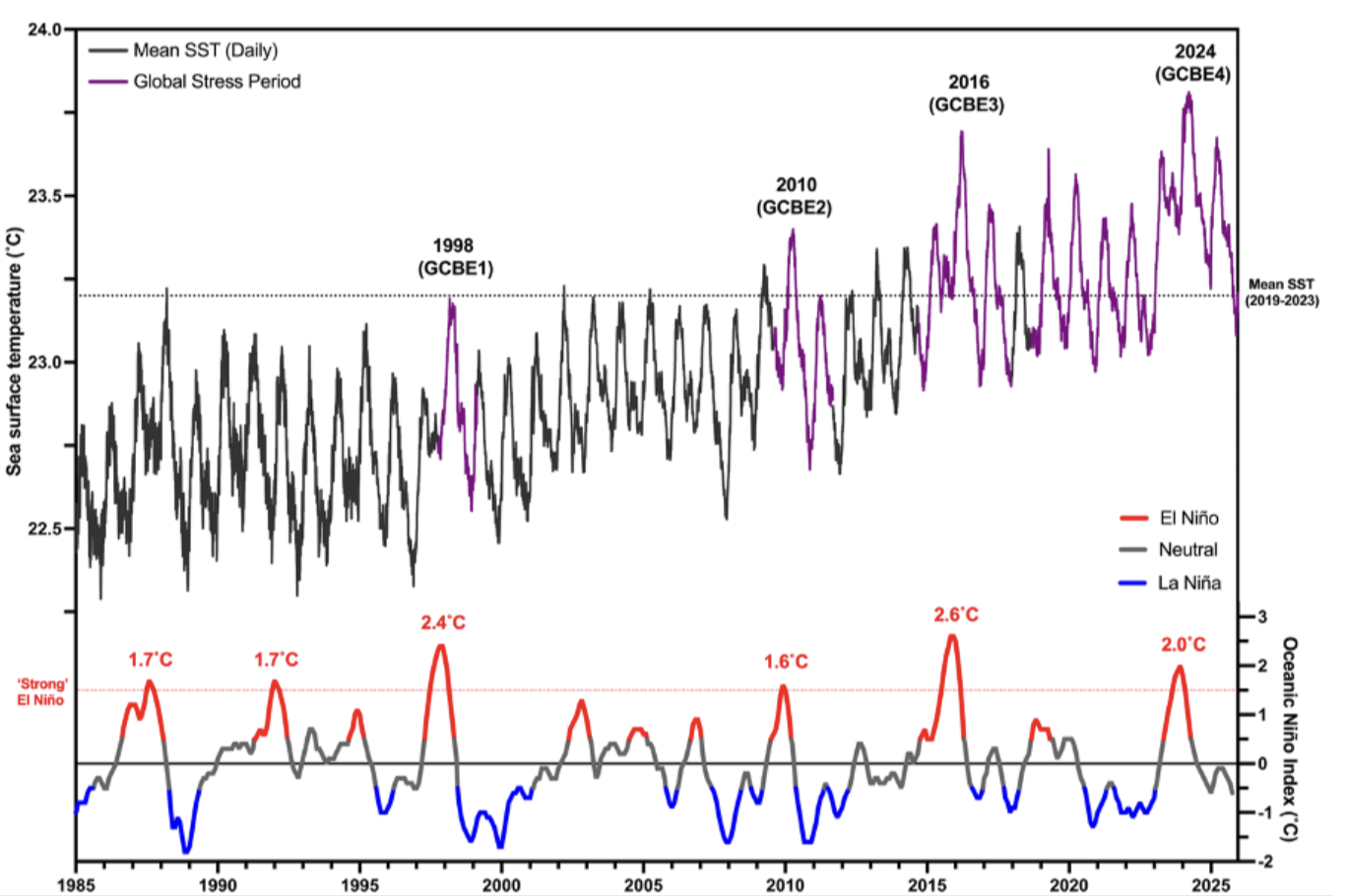
Trends in global sea surface temperature (SST) (Top black lines) and El Niño-Southern Oscillation (ENSO) strength (Bottom blue, grey and red lines) from 1985-2025 highlighting associations with global coral bleaching events (GCBE). Source: Spady et al. 2026
Ecological and Socio-Economic Impacts
Mass coral bleaching has devastating impacts on corals and coral reef communities. Corals that are bleached or recovering from bleaching are likely to experience reduced growth rates, decreased reproductive capacity, increased susceptibility to diseases and elevated mortality rates. In addition, widespread coral mortality following a bleaching event can alter coral community composition, due to the selective loss of the more susceptible species, as well as reef-scale declines in genetic and species diversity. Reef degradation from coral bleaching erodes the quality and quantity of reef ecosystem services such as coastal protection, fisheries production, and recreation. These can have catastrophic consequences on the livelihoods of communities and increase their vulnerability to poverty and malnutrition.
Management Strategies
While managers cannot directly prevent coral bleaching from affecting the reef, their responsibilities include:
- Preparing stakeholders for the outcome
- Limiting the impact and increasing the chances of recovery by maintaining reef resilience through management actions (e.g., wastewater management, fisheries management)
- Restoring affected reefs with Climate-Smart strategies
A bleaching response plan enables managers to be ready should a bleaching event occur. It describes the steps for detecting, assessing, and responding to bleaching events and can take many forms, from a complete management response framework (e.g., Great Barrier Reef Marine Park Authority’s Incidence Response System) including an incident control system and field procedures to a simple one-page description of key steps and triggers.
The four main elements of a bleaching response plan are:
- An early warning system
- Impact assessment
- Management interventions
- Communications
The Reef Resilience Network developed a worksheet to guide managers through developing a bleaching response plan.
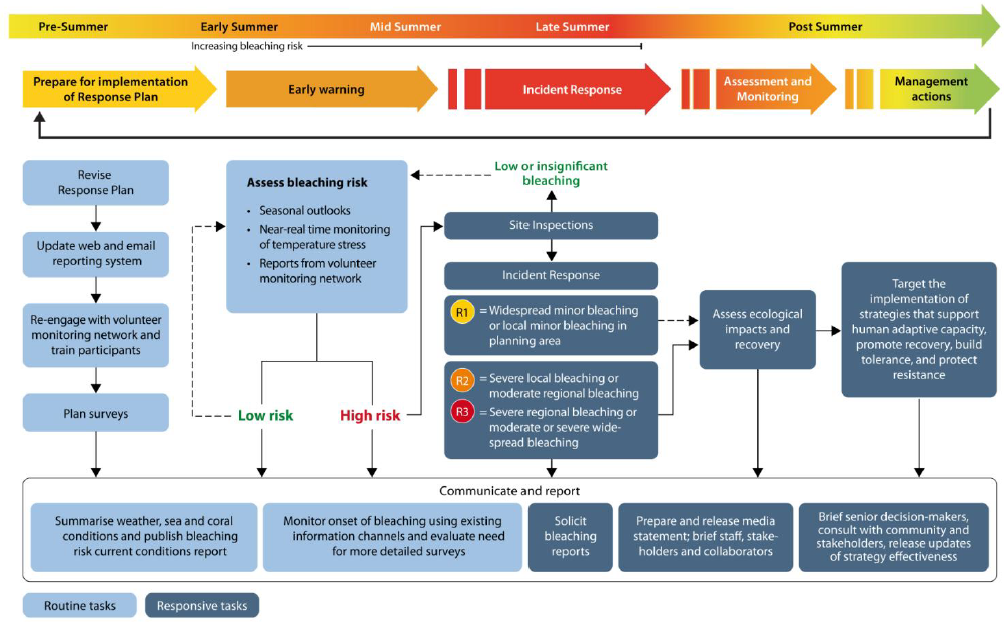
Coral bleaching response plan developed by the Great Barrier Reef Marine Park Authority (GBMPA) in Australia. Source: GBRMPA 2011
A range of coral bleaching monitoring tools are available to managers worldwide, including remote sensing platforms like the Allen Coral Atlas, global monitoring programs such as Reef Check and MERMAID, and regional networks like the Coral Reef Alliance. Sharing observations across these regional and global networks is essential to enhance understanding, improve mitigation strategies, and strengthen adaptation efforts in response to coral bleaching events.
Once a reef has been affected by a coral bleaching event, managers might wish to consider local management interventions or restoration strategies to support recovery processes. However, coral bleaching events often occur at spatial scales of tens to hundreds of kilometers, making restoration an expensive and difficult, if not impossible, prospect.