
Coral Bleaching Biology

Elevated seawater temperatures in combination with strong sunlight cause thermal stress in corals. This stress can cause disruption of normal photosynthetic processes in the coral’s zooxanthellae which leads to coral bleaching.
When a coral is bleached, the colony will have a shiny white appearance as the polyps are free of the zooxanthellae and therefore transparent. A bleached coral is alive but functioning with less than 95% of his nutritional source. Corals can survive for several days or months without their zooxanthellae, but their ability to survive depends upon the level and type of stress and the sensitivity of the coral. If stressors persist, corals may starve and die. If stressors do not persist, then the corals may regain zooxanthellae and recover. However, even if corals survive bleaching, they may suffer sub-lethal impacts such as reduced coral growth rates and reproduction and increased susceptibility to disease.
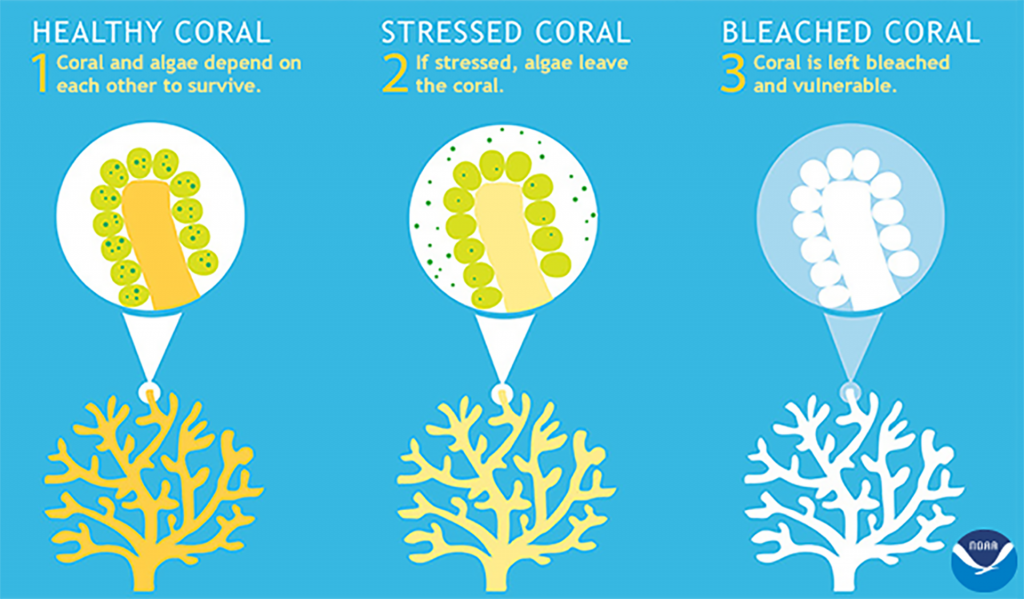
Source: National Oceanic and Atmospheric Administration
Variations in Bleaching Susceptibility
Corals differ widely in their susceptibility to bleaching. Historically, bleaching risk followed a fairly consistent pattern, with complex, branching corals tending to be more vulnerable and massive species, particularly those with fleshy polyps showing greater resistance. ref However, this pattern is no longer consistent. Susceptibility now varies across reef regions and is strongly influenced by prior bleaching history. ref For example, during the 2015-2017 bleaching event in the Mesoamerican Reef system, some branching species of Acropora were less susceptible to bleaching than several massive coral species. ref
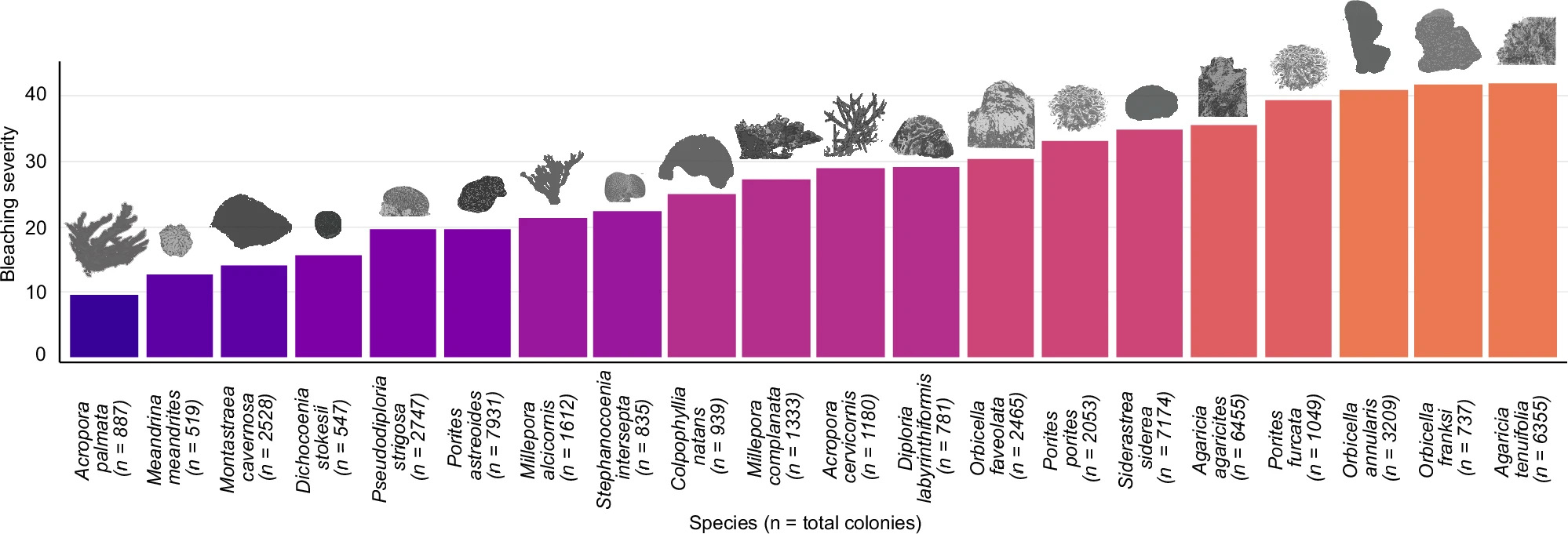
Bleaching severity index across species in the Mesoamerican reef system during the 2015-2017 bleaching event. Source: Muniz-Castillo et al. 2024
Coral reefs’ susceptibility to bleaching may also vary based on the conditions to which a reef has adapted, its species composition, and reef zonation. ref Corals on reef flats, for example, will often be able to tolerate much higher water temperatures than colonies of the same species inhabiting reef slopes. Within reefs, bleaching susceptibility also varies depending on colony size and stress intensity, ref and two colonies from the same species may exhibit varied responses to stress.
The type of zooxanthellae can also influence bleaching susceptibility. Various species of zooxanthellae (from the genus Symbiodiniacea), previously referred to as “clades”, ref have different sensitivities to stressors. Their paring with host-corals therefore influences the coral’s ability to be more resistant to higher temperatures. However, corals with heat-resistant symbionts tend to grow more slowly, ref which is perhaps one reason why slower-growing coral species can sometimes be more tolerant to thermal stress.