Climate-Smart Management Planning in the Bahamas
Location
Nassau, Bahamas
The challenge
The Bahamas has designated one of the largest systems of marine protected areas (MPAs) in the wider Caribbean. This network covers more than 17% of the country’s nearshore environments, with MPAs within this system comprising nearly 6.8 million hectares (16.8 million acres). ref Healthy, well-managed MPAs support the thriving ecosystems that sustain a profitable nature-based tourism industry and the growth of more robust fish populations important to local fishers. “Tourism is our number one industry and MPAs play a critical role in that,” said Lakeshia Anderson-Rolle, Executive Director of the Bahamas National Trust (BNT). BNT manages 33 national parks and protected areas, including both land and marine areas, spread throughout the Bahamian archipelago.
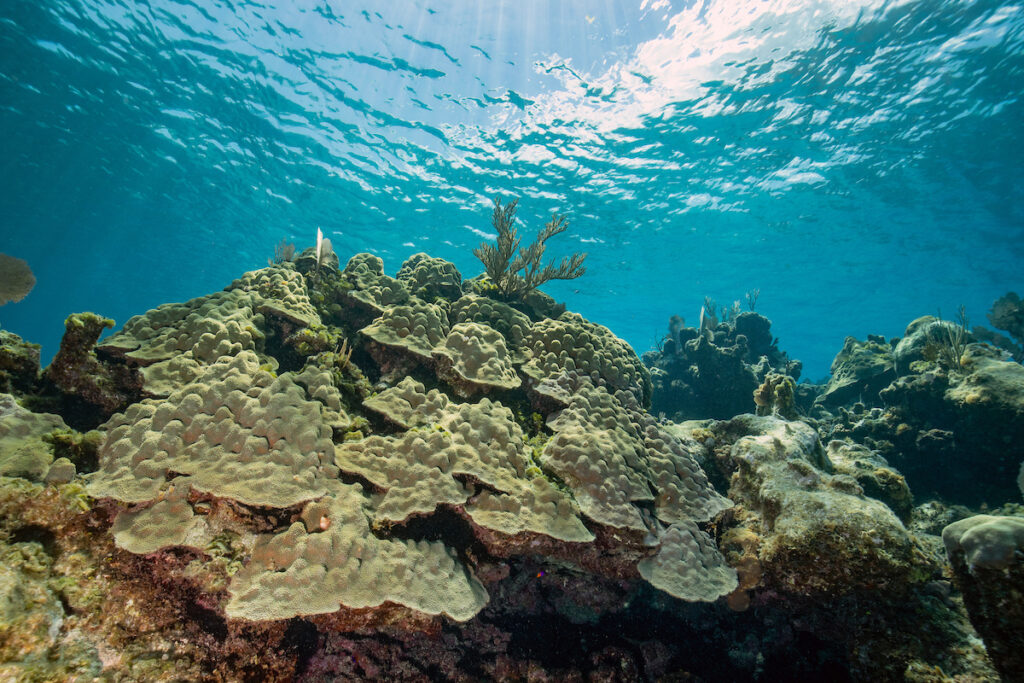
Star coral near Eleuthera Island, The Bahamas. Photo © Kip Evans
As a small island nation, climate change is an ever-present, tangible threat. Recent devastating storms, increasing sea surface and air temperatures, and sea level rise are just some of the climate threats challenging managers of The Bahamas’ protected areas. Addressing these challenges had previously been seen as a global issue that “was too broad in scope” to be addressed in park management plans. As they considered how to address the challenge of climate change, BNT recognized a need for planning tools and processes to incorporate climate change into their management planning efforts. In addition, as part of The Bahamas Debt Conversion Project for Marine Conservation announced in 2024, The Bahamas has committed to effective MPA management by incorporating Climate-Smart objectives and strategies into management plans. ref
To meet these commitments, BNT will incorporate Climate-Smart management strategies into management plans for the national parks and protected areas they manage over the next 15 years under this project. The management plans that were amended by BNT through the process described below will count towards these commitments. The Bahamas’ commitments under the debt conversion provide a strong incentive to invest in capacity strengthening for Climate-Smart management planning (CSMP).
Actions taken
In 2023, BNT expressed an interest in building capacity to incorporate climate change into their new and existing management plans. The Nature Conservancy (TNC) Northern Caribbean Program and Reef Resilience Network (RRN) responded by helping BNT to understand their needs and reviewing available tools for integrating climate change and resilience-based management into conservation planning. Based on this review, RRN developed a framework to help resource managers deliberately address climate impacts in existing management plans.
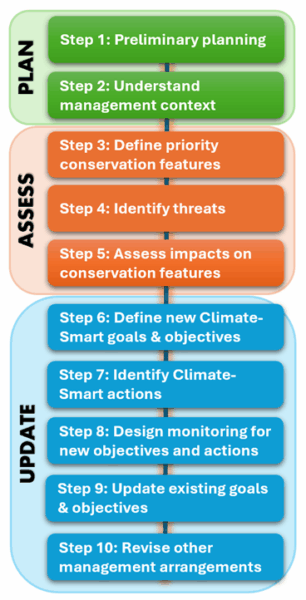 This framework is based fundamentally around the concepts developed in the seminal Climate-Smart Conservation ref, as well as similar tools such as Climate Change Adaptation Framework for Parks and Protected Areas ref, Climate-Smart Conservation Practice: Using the Conservation Standards to Address Climate Change ref, Planning for a Changing Climate: Climate-Smart Planning and Management in the National Park Service ref and the Climate Change Resilience and Adaptation Planning Tool ref. The specific contribution of the RRN-developed framework is to provide practical exercises and activities which can be used to rapidly assess and incorporate Climate-Smart updates into existing plans. Importantly, this framework is designed to be broadly adaptable for use in diverse management contexts and locations around the globe.
To roll out the process of training BNT staff to apply the new framework, from March 2024 – March 2025, RRN partnered with TNC Northern Caribbean Program and BNT to hold a series of workshops in The Bahamas to develop capacity for CSMP and to assist with development of Climate-Smart management plans for three prioritized marine protected areas. Over the course of four workshops, RRN provided training to 39 participants from seven agencies involved in management of protected areas and other natural resources in The Bahamas. Participants learned about the threats and impacts of climate change, available climate projections for The Bahamas, and the concept of Climate-Smart adaptation. Participants were led through the framework developed by RRN to update management plans to ensure they are Climate-Smart.

Attendees work with an RRN facilitator at the July 2024 TNC-BNT CSMP workshop. Photo © Jane Israel
To pilot and refine the framework, two of the workshops focused specifically on working through the framework with BNT planners, scientists, and park managers. Specifically, the BNT parks director and science director, six park managers and wardens, three BNT planners, and five science officers, came together over the workshops facilitated by a team of four facilitators from RRN to apply the framework and update the three park management plans. In addition, virtual meetings prior to and after the workshops provided additional information for key conservation features, as well as touchpoints for BNT planners and managers to ask questions and check-in as they worked on their Cimate-Smart management plan updates.
Through this initiative, RRN also developed a practical guide and supplementary materials, which are available on the RRN website as a resource for managers and planners interested in developing Climate-Smart management plans.

Click the cover image to access a downloadable PDF of the Guide.
How successful has it been?
This initiative provided substantial benefits to BNT and The Bahamas and to managers globally who are looking to update or develop management plans that are Climate-Smart, with the following outcomes:
- Three national park management plans were updated to incorporate Climate-Smart objectives and strategies. With facilitation from RRN coaches to work through the CSMP framework, BNT incorporated Climate-Smart objectives, strategies, and actions into the management plan for their flagship park, Exuma Cays Land and Sea Park, as well as plans for Lucayan National Park and Moriah Harbour Cay National Park.
- Capacity for CSMP is strengthened at BNT and its partner agencies. Through the workshops, BNT staff and partners at 6 other agencies received training to better understand climate change threats and strengthened their capacity to plan for managing those threats. Government departments in The Bahamas are now in a better position to meet their commitments for The Bahamas Debt Conversion Project for Marine Conservation, for developing Climate-Smart management plans for their MPAs.
- A new framework to rapidly assess and incorporate Climate-Smart updates into management plans is available for use. RRN partners in The Bahamas and worldwide can benefit from the new guidance and materials that were created for this CSMP framework.
Lessons learned and recommendations
Through the CSMP initiative, several lessons learned came to light:
- Helping managers to understand the need to plan and manage in the face of uncertainty is critical. The fundamental uncertainty around climate change impacts and projections poses challenges for planners and managers, but the framework reinforces the need to address climate change and not wait for more certainty.
- Taking into account capacity constraints is key. Agencies may have limited resources (e.g., staff time and funding). To ensure success, it is helpful to consider what is realistic and what is required in terms of updating management plans, and to focus CSMP efforts accordingly.
- Employing a facilitated versus an independent process is helpful when learning and applying a new, comprehensive framework. A facilitated process worked well to pilot the CSMP framework, update BNT’s three selected management plans, and increase CSMP capacity at agencies in The Bahamas. However, the framework can also be applied independently by an individual or smaller team over a longer time frame using the guidebook and supplemental materials.
- Scheduling virtual meetings pre- and post-workshop allows for important additional support and learning. Virtual touchpoints allowed time for providing background information prior to workshops, and for BNT to get additional insights for their management plans from the resource and Climate-Smart experts leading the workshops. Virtual meetings were also conducted to allow time for BNT to provide feedback as the framework was refined and completed.
- In addition to updating existing plans, the CSMP framework can be adapted to apply to developing new management plans. While the framework does not cover all the steps needed to develop a new management plan, it provides useful information for practitioners to understand how to integrate Climate-Smart planning when developing a new management plan.
- Prior to undertaking Climate-Smart updates, it is important to screen existing management plans. Considerations should include:
- Where in the update cycle is the plan? If the management plan includes mostly outdated information and objectives, consider how to most efficiently incorporate climate considerations, perhaps by waiting until the management plan is due for an overall update.
- Are there other related efforts (e.g., zoning plans or carrying capacity plans) being undertaken? If so, consider whether schedules should be aligned and where Climate-Smart updates fit best.
- The CSMP framework can be applied to update multiple plans at once. Suggestions for ways to consolidate the process (rather than undertaking one plan at a time) include:
- Grouping sites that are similar to develop Climate-Smart updates at the same time.
- Convening experts to develop overview and impact assessments for key conservation features, which can be used across multiple plans.
- Developing a standard list of strategies for common climate change threats and impacts.
Funding summary
This initiative was supported by RRN with additional assistance from TNC Northern Caribbean Program and funded through the BahamaReefs Programme, a long-term initiative led by TNC in partnership with the Global Fund for Coral Reefs.
Lead organizations
The Nature Conservancy Reef Resilience Network
The Nature Conservancy Northern Caribbean Program
Partners
Government of The Bahamas departments, including:
Antiquities, Monuments, and Museum Corporation
Department of Marine Resources
Department of Environmental Planning and Protection
Office of the Prime Minister, Sustainable Development Goals Unit
Clifton Heritage National Park
Resources
Adaptation design tool: corals and climate adaptation planning
Writing SMART objectives for natural resource and environmental management