
Scoping an MCS&E System

Blue Nature Alliance partnered with the WildAid Marine Program to develop the following activity to help MPA management and enforcement teams assess enabling conditions and identify priority actions to implement or improve MCS&E systems in their areas. The activity below will walk you (along with your colleagues) through creating your own MCS&E “Sail Plan.”
Phase One: Assess Enabling Conditions
Much as radar’s purpose within an MCS&E system is to detect and track vessels in your area, the purpose of creating an "MCS&E Radar” is to observe the context for MCS&E in your area and identify actions that best meet the challenges and opportunities you are facing. This activity can be completed on your own, with your team, or even across multiple departments and organizations. Various agencies and departments are likely to have different perspectives on your local context, so collaboration will create a richer understanding. A completed MCS&E Radar can also be used as a communication tool to support future collaboration.

The MCS&E Radar worksheet, modelled from WildAid's Blueprint Protection System. Source: Blue Nature Alliance/WildAid
The elements that need to be in place for an effective MCS&E system to be implemented are referred to as enabling conditions. The MCS&E Radar worksheet (click here to download a printable PDF) organizes enabling conditions by the following key topics:
- Policies, legislation, and regulations
- Monitoring and surveillance
- Enforcement
- Community Engagement
- Partnerships
- Capacity sharing and training
- Funding
*If there are any key topics for your area missing from the list above, you can add them to the blank wedge of the radar circle.
Consider the strategies and mechanisms covered in the earlier pages of this toolkit for your area, and follow these steps:
- Consider which activities, strategies, or partnerships are most applicable for your context. What MCS&E actions are you already taking? What do you know you are missing? Make a list of these actions. Be sure to distinguish between the actions you are already taking and those that you are missing (e.g., by using two different colors of sticky notes), so that you can increase your focus on filling in the gaps.
- Sort the actions you’ve identified into the topic areas on the radar sheet. This can be done digitally by opening the radar image in a document or slide editor and adding, clicking, and dragging text elements, or in person by writing actions onto sticky notes and placing them on the appropriate area of the radar circle. (See example below.)
- Once you have added all the identified actions to your radar worksheet, review the overall picture of what you’ve identified. Are there areas where you are particularly strong or weak? Are there actions or areas where your efforts are likeliest to succeed, or areas where you face specific roadblocks?
- As you reflect on the questions above, prioritize the actions that will help you fill the gaps in your system by moving them closer to the center of the circle. Identify 3 high priority actions and 5 medium priority actions to move forward with in your planning.
- For each of your priority actions, list at least one enabling condition that will support its implementation.
(Click to Toggle Language)
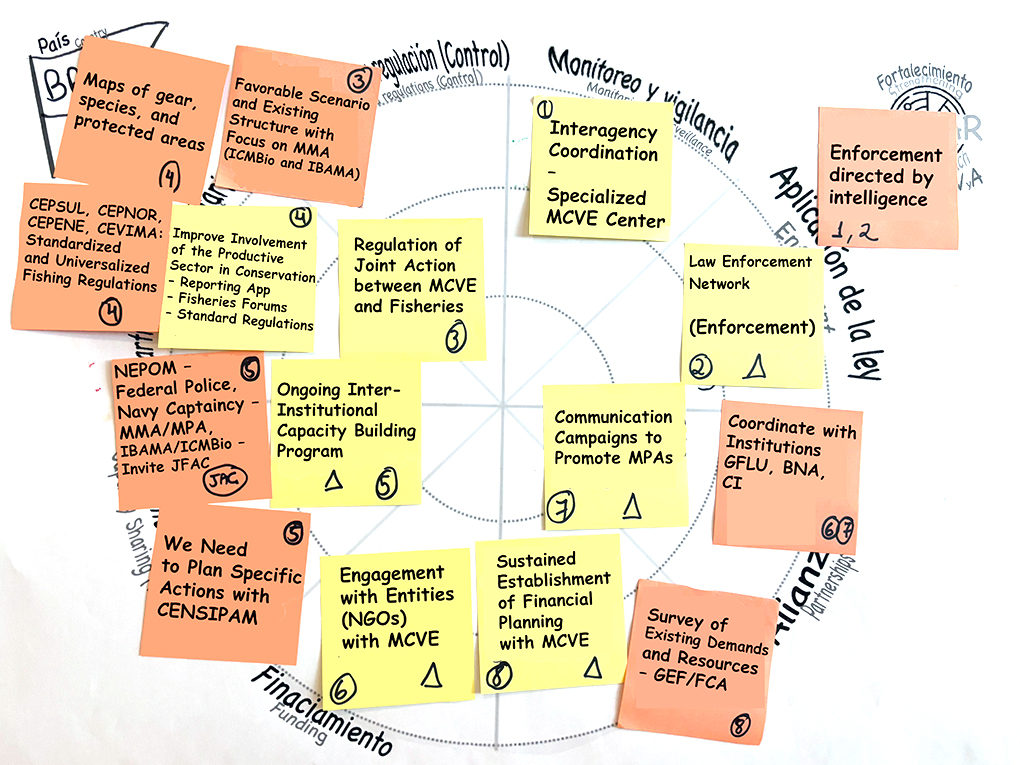
An MCS&E RADAR worksheet completed by the Brazil country team at the LSMPA Enforcement Learning Exchange, Colombia (digitally modified to show English translation). Source: Blue Nature Alliance/WildAid
Phase Two: Build an MCS&E Sail Plan
A Sail Plan is a way to visualize the priority activities identified by your MCS&E Radar, to help you enhance your enforcement efforts. The Sail Plan also provides a way to share your scoping results with your department, partners, or other stakeholders, which may inspire further partnership and collaboration necessary to continue moving your MCS&E system forward.
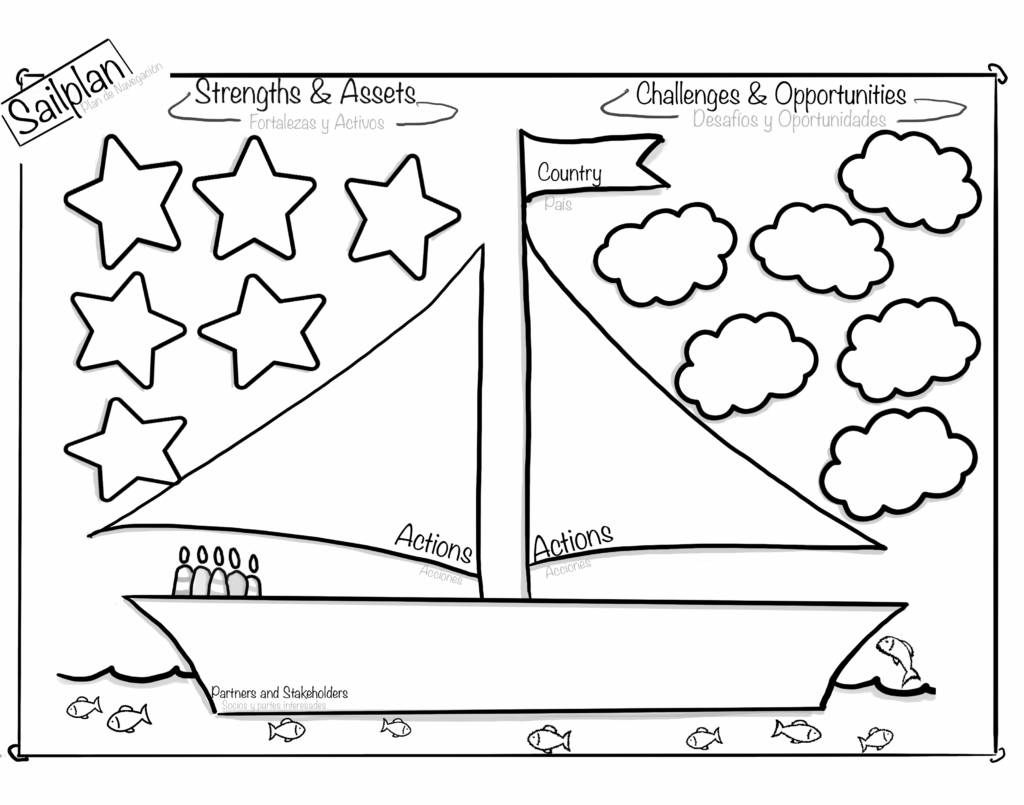
The MCS&E Sail Plan worksheet. Source: Blue Nature Alliance/WildAid
Perform the following tasks to complete the Sail Plan (click here to download a printable PDF). This can be done digitally by opening the Sail plan graphic in a document or slide editor and adding text, or by printing the file and writing answers directly or placing sticky notes on the Sail Plan.
- Strengths and Assets
Place your answers to the following questions in the stars:
- What assets or other supports are available to your MPA?
- What opportunities, technologies, organizations, and relevant experiences are currently available?
- What are specific leadership capacity building activities, opportunities, and experiences that are currently available?
- What networks, connections, and communications pathways are available?
- Challenges and Opportunities
Place your answers to the following questions in the clouds:
- What constraints are currently limiting MCS&E in your MPA?
- What barriers do you face before you can implement your priority actions?
- What places, issues, or resources require attention before you can proceed?
- Charting the Destination
It’s time to put some wind in your sails! Consider your strengths and opportunities and propose actions that will mitigate your challenges and improve your MCS&E system.
- Review the high- and medium-priority actions from your MCS&E RADAR worksheet.
- Considering the needs (in the clouds) and the assets (in the stars) on your Sail Plan, add 3-5 actions from your RADAR worksheet to the sails on the Sail Plan. These should be actions that directly address the challenges or add to the strengths of your MCS&E system.
- Draw a line that connects each of the actions on your sails with the cloud or star that it impacts or advances.
- Building a Foundation
Working with partners, networks, and other stakeholders is critical to improving MCS&E. To the hull of the boat, add the names of partners, organizations, and other key groups or individuals who will help you keep your MCS&E system moving forward.
(Click to Toggle Language)
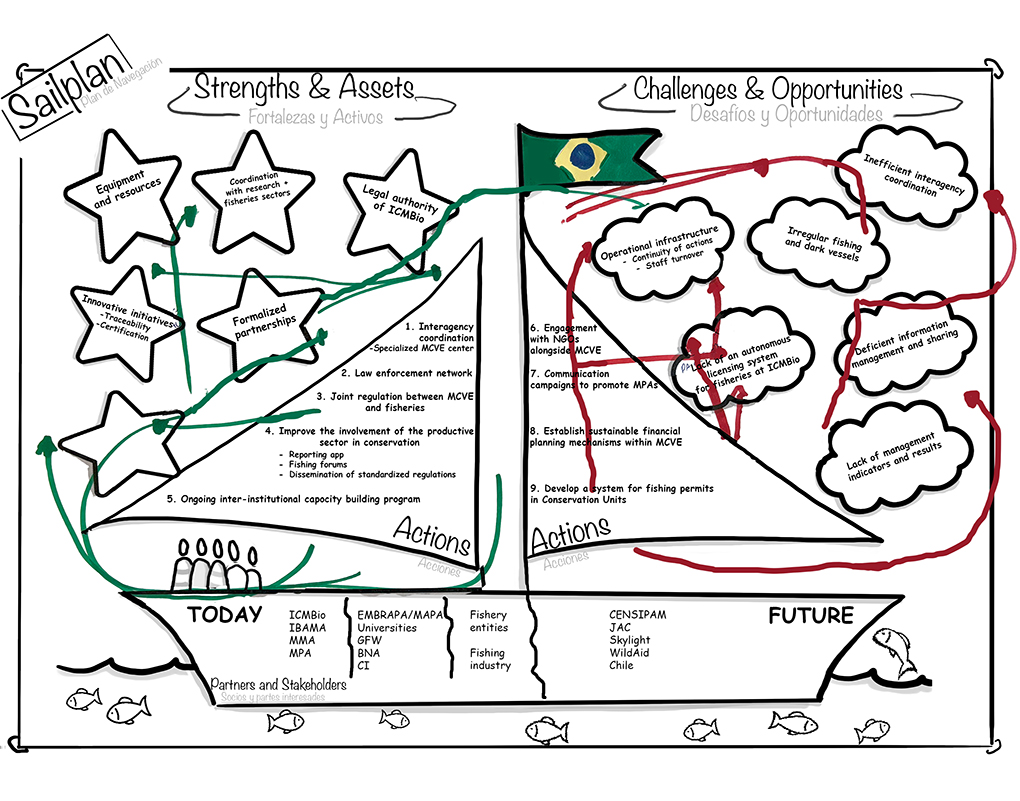
An MCS&E Sail Plan completed by the Brazil country team at the LSMPA Enforcement Learning Exchange, Colombia (digitally modified to show English translation). Source: Blue Nature Alliance/WildAid
Phase Three: Next Steps
Your completed MCS&E Radar and Sail Plan have helped you to identify, consider, and collate your priority actions, but this is just a starting place to support further planning, communication, and implementation. Next steps can include:
- Develop an action plan with specific tasks identified to enact your priority actions.
- Present the action plan to relevant stakeholders and agencies to obtain feedback, buy-in, and support.
- Explore what other agencies, stakeholders, and other actors in your area are doing and identify synergies and opportunities for collaboration.
- As you learn more and start to implement priority actions, return to these activities with your collaborators to further refine your priorities.
The MCS&E Radar and Sail Plan activities were piloted at the LSMPA Enforcement Learning Exchange, funded and hosted by Blue Nature Alliance and WildAid, where the activity was completed by small teams from nine countries across the Latin America region. The activities presented on this page are suitable for completion by individuals or groups, across multiple departments, agencies, and scales, through in-person or virtual engagements.