
Reef Exchanges Podcast

The Reef Exchanges podcast connects Network members to managers and other experts from around the world. Each episode features an in-depth discussion around the latest developments in marine science and management, linking strategies and insights to concrete actions and useful tools. You can listen to episodes below, or find them wherever you listen to podcasts.



Episodes
Episode 12 | The Gathering Storm: Preparing for a Very Strong El Niño
Guest: Julia Rose, Coral Restoration Program Manager, TNC in Hawai’i
Description: On this episode, Julia talks about her experiences performing coral bleaching monitoring during the 2015-2016 El Niño and mass coral bleaching in Hawai’i event and how they have influenced ose experiences influenced her decisions and actions in the ensuring years since. She shares the reality of her personal experience monitoring coral reef loss, as well as actions she’s taking and where she’s finding hope as we prepare for this year’s very strong El Niño. Please note: Throughout the episode, we use the colloquial term “Super El Niño,” but the formal NOAA classification for this year’s event is a “very strong El Niño.”
Date: 9/8/2026
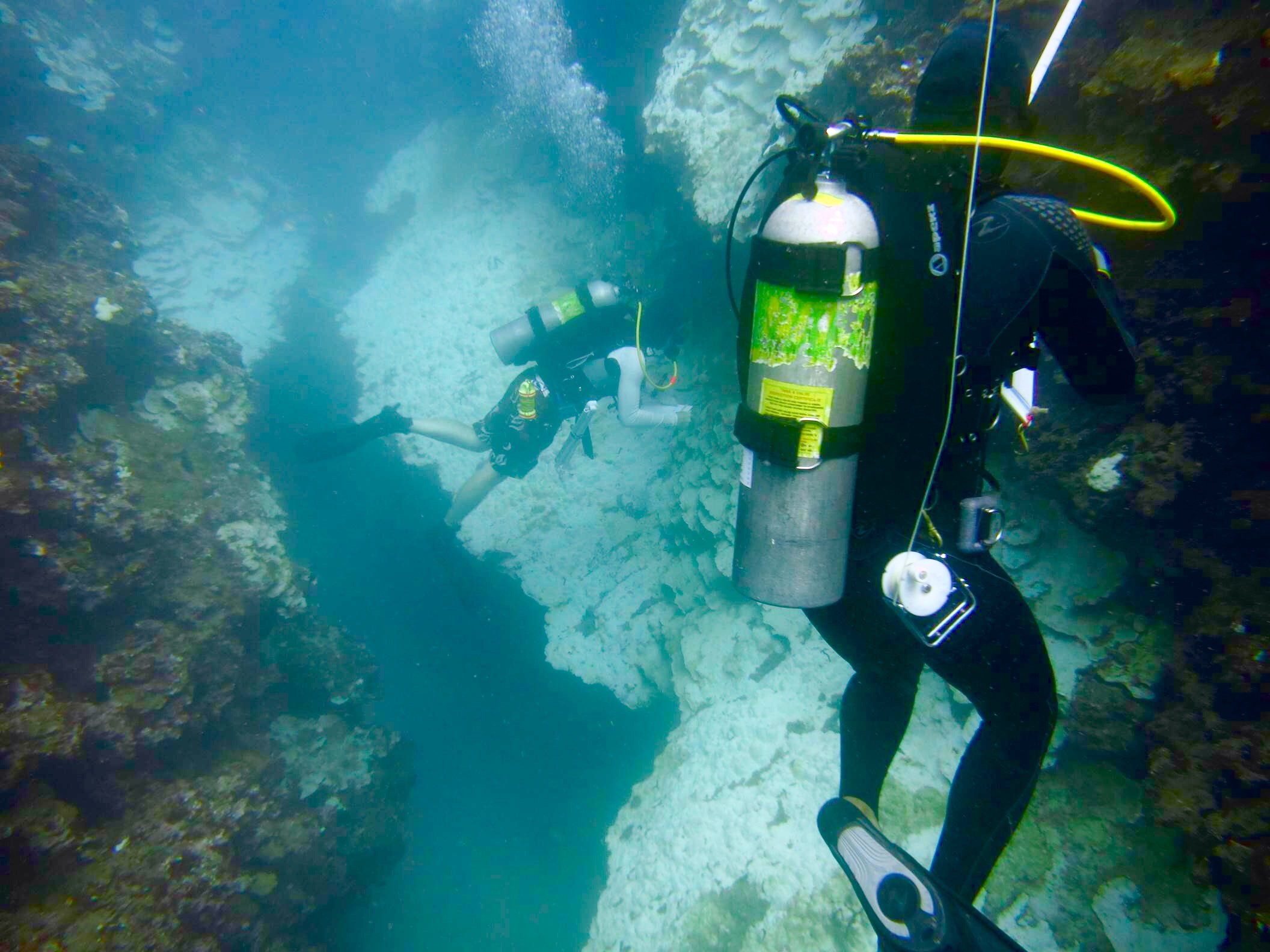
TNC Hawai'i personnel conducting monitoring during 2014-2015 mass coral bleaching event. Photo credit: Cecile Walsh
Episode 11 | Confirm, Then Act Fast: Encountering Invasive Soft Corals in Puerto Rico
Guest: Daniel Toledo-Rodriguez, Researcher, University of Puerto Rico, and Dr. Nilda Jimenez, Endangered Species Program Coordinator, Puerto Rico Department of Natural and Environmental Resources
Description: On this episode, Daniel and Nilda talk about their recent work looking into invasive soft coral species that have been found in Puerto Rico’s coral reef ecosystems. From collecting samples and conducting genetic testing to conducting outreach with local dive shops, Daniel and Nilda discuss the actions they’ve been taking to marshal the resources and time needed to rapidly address invasive soft corals.

Latissimia ningalooensis is located in the center of the image surrounded by Xenia umbellata. Photo © Daniel A. Toledo-Rodriguez
Episode 9 | Hold it Together: Stabilizing Rubble for Reef Restoration
Guest: Suki Leung, Research Assistant, University of Queensland Marine Spatial Ecology Lab and Dr. Margaux Hein, Lead Consultant, MER Research and Consulting
Description: In this episode, originally recorded for the 2025 Coral Reef Restoration Mentored Online Course, we speak with Suki Leung at the University of Queensland Marine Spatial Ecology Lab. Suki joins course mentors Margaux Hein and Caitlin Lustic to discuss methods and approaches for rubble stabilization in coral reef areas, an often crucial step in preparing an area for coral restoration activities. Many potential restoration sites have been damaged or degraded to the point that they no longer provide suitable habitat for coral settlement or growth. Whether through rubble stabilization or installing artificial reefs, physical restoration techniques are literally foundational practices for effective coral reef restoration.
The opinions that Suki expresses are hers alone and not those of The University of Queensland or Reef Restoration & Adaptation Programme (RRAP).
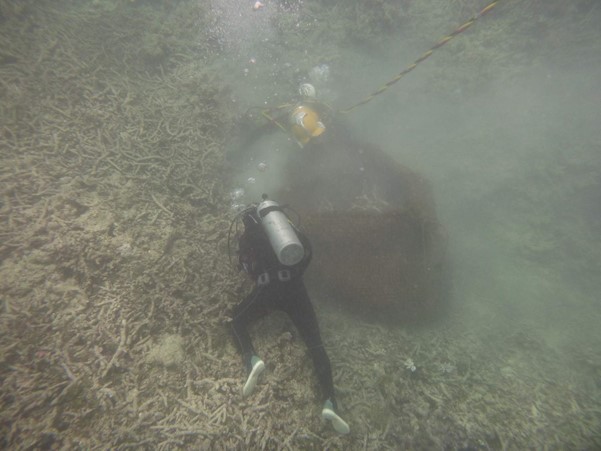
Reef bags are used to collect rubble on a degraded reef in Australia. Photo © Tom Baldock.
Date: 2/23/2026
Episode 10 | Just Graze: Restoring Herbivores to Coral Reefs in Saba
Guest: Dr. Alwin Hylkema, Associate Professor, Coastal Ecosystem Restoration at Van Hall Larenstein University and Wageningen University
Description: In many areas of the Caribbean, coral reefs are being overwhelmed by algae. A combination of causes (e.g., eutrophication, overfishing of herbivorous fish and urchins, and species die-offs) has led to faster-growing algae with fewer and fewer grazers, preventing corals from recruiting and recovering from disturbances. As the corals die off, they leave more space for algae, and the remaining herbivores simply can’t keep up with this unvirtuous cycle. On this episode, Dr. Alwin Hylkema tells us about studies he and his team have conducted showing that, if we can increase grazing pressure, then algae cover will decrease and coral recruitment will improve. Alwin describes his work restoring local sea urchins to the reef, and the potential for combining herbivore restoration with coral reef restoration through “tandem restoration” that can improve outcomes across a reef system. You can read a summary of Restoration of herbivory on Caribbean coral reefs: are fishes, urchins, or crabs the solution? at reef resilience dot org.
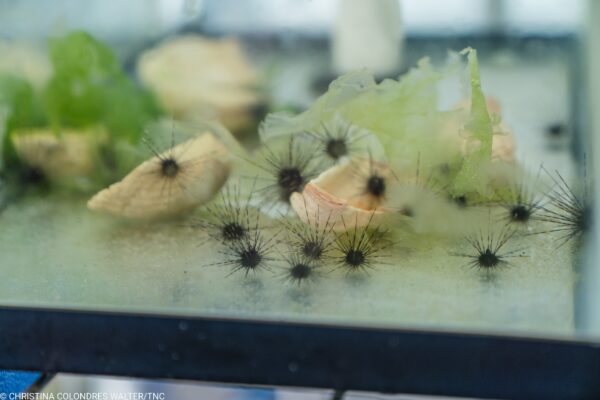
Sea urchins growing inside an aquarium, Puerto Rico. © Christina Colondres Walter/TNC
Date: 3/2/2026
Episode 8 | Help from on High: Monitoring Coral Bleaching with Drones
Guest: Dr. Steve Schill, Lead Scientist, Caribbean Division, The Nature Conservancy
Description: As a part of Bleaching Awareness Month, led by our partners with the Coral Reef Alliance and International Coral Reef Initiative, we check in with longtime friend of the Network, Dr. Steve Schill. Steve talks with Henry and Annick about the process of going from using a small drone affixed with a digital camera to survey reefs to operating a fixed-wing surveillance drone that can monitor hectares of reef area in a single day’s work. As the frequency and severity of coral bleaching events increases, having the ability to conduct rapid reef monitoring enables managers to make timely and effective decisions.

A drone orthomosaic image of Lew’s Reef in St Croix, USVI, showing the APAL colonies in 2021. Photo credit: Steve Schill/TNC
Date: 11/10/2025
Episode 6 | Trust the Process: Climate Adaptation Planning in The Bahamas
Guest: Ellsworth Weir, Director of Parks, and Alyssa Bastian, Parks Planner, Bahamas National Trust
Description: In collaboration with The Nature Conservancy Northern Caribbean Program, the Reef Resilience Network created a process for updating MPA management plans to be Climate-Smart and led implementation of that process with the Bahamas National Trust (BNT). In this episode, we sit down with two BNT staff to learn about their experience. Ellsworth Weir, the Director of Parks, and Alyssa Bastian, a Parks Planner, provide their perspectives of working to prepare their parks for the impacts of climate change. They share advice for MPA managers and planners who are just beginning to think about updating management plans to be Climate-Smart. You can read more about the project through this case study, hear more from Alyssa through this webinar recording, and take a deeper dive into the process through the Climate Adaptation Toolkit.
Date: 8/7/2025
Episode 7 | Improving Reef Monitoring Efficiency with MERMAID
Guest: Dr. Emily Darling, Director of Coral Reef Conservation and Co-Founder, MERMAID, and Shinta Pardede, Ecologist, Wildlife Conservation Society in Indonesia
Description: In response to the excitement and interest across the Network in MERMAID after our webinar on the topic earlier in 2025, we invited Dr. Emily Darling back to talk with us a little more about how she developed the MERMAID platform. Emily brings along Shinta Pardede, who tells us more about her experience using MERMAID in the field in Indonesia. We also ask a couple of questions that we didn’t have time to get to during the webinar. Access this free guide to learn more about how to use MERMAID.
Date: 10/28/2025
Episode 5 | Financing an MPA: The Blue Alliance Approach
Guest: Dr. Angelique Brathwaite, Director of Conservation and Science, Blue Alliance
Description: Historically, funding for MPAs has often fallen short of what is needed to ensure effective management and successful outcomes. At the same time, governments around the world are increasing their commitments to create and expand protected areas, bringing further attention to the need to secure adequate funding and prevent MPAs from becoming “paper parks.” In this episode, Dr. Angelique Brathwaite (Angie) describes Blue Alliance’s innovative MPA financing model, which supports “reef-positive businesses” that create positive outcomes for ecosystems and communities by returning revenue back to management efforts. Listeners will learn about successes that Blue Alliance MPAs have experienced in generating income to support effective MPA management.
Date: 4/24/2025
Episode 4 | Management Effectiveness for MPAs
Guest: Lauren Wenzel, Director, National Marine Protected Areas Center, National Oceanic and Atmospheric Administration
Description: With the Convention on Biological Diversity’s ambitious 30x30 commitment—aiming to increase the coverage of "effectively conserved and managed" areas to 30%—there is renewed attention on the pivotal role marine managers can play in achieving this goal. In this episode, Lauren discusses whether there is a minimum level of effective management required for an MPA to count towards a country's 30x30 goals, what it means to adopt management effectiveness standards, and practical steps managers can take to navigate the current focus on 30x30 commitments and ensure their areas are effectively managed.
Date: 1/28/2025
Episode 3 | A Deeper Dive into Mesophotic Reefs
Guest: Dr. Jessica Bellworthy, recently a postdoctoral fellow, University of Haifa and Camille Kaczmar, master’s student, UCSB Bren School of Environmental Science & Management
Description: As climate change threatens tropical coral reefs with warming waters, the search for areas where water temperature remains relatively cool during warming events has become a critical area of research. One avenue of research—known as the Deep Reef Refugia Hypothesis—is investigating whether mesophotic coral ecosystems can provide sanctuary for tropical corals facing warming sea surface temperatures. A key aspect of the Deep Reef Refugia Hypothesis is vertical connectivity—how larvae and genetic material move between shallow and deeper reefs. In this episode, Camille explains the context for why mesophotic reefs and vertical connectivity are relevant for reef resilience, and Dr. Bellworthy walks us through research she conducted to test the Deep Reef Refugia Hypothesis in the Gulf of Aqaba. Visit mesophotic.org to learn more about mesophotic ecosystems.
Date: 1/16/2025
Episode 2 | Getting Started with MPA Enforcement
Guest: Sunny Tellwright, Program Manager for Ocean Technology & Innovation at Conservation International
Description: MPA Enforcement can be critical to effective coral reef management efforts, and many members of the Reef Resilience Network have identified enforcement as an area where they need more training and support. To address these needs, the Network, in partnership with Blue Nature Alliance and in close collaboration with WildAid, is developing a suite of online resources (including this Reef Exchanges episode, a webinar, case study, and online toolkit) for marine managers on MPA enforcement.
During this episode, Sunny provides an overview of the core concepts behind Monitoring, Control, Surveillance, and Enforcement (MCS&E), including how context-dependent and people-powered MCS&E systems are. The episode ends with some key considerations for managers to keep in mind as they being to scope their own MCS&E systems.
Date: 10/10/2024
Episode 1 | Making the Case for Nature-Based Wastewater Solutions
Guest: Rob McDonald, Lead Scientist for Nature-based Solutions at The Nature Conservancy
Description: Nature-based Solutions provide an alternative to traditional gray infrastructure by using natural processes to capture and treat contaminated water before discharging it into the ocean or waterways. Wastewater can have negative impacts on coral reefs and human health, primarily through transporting pathogens, nutrients, and contaminants into the ocean. It is estimated that 80% of wastewater globally is discharged into the environment without any treatment at all.
In addition to introducing Nature-based Solutions and how they combat wastewater pollution, Rob helps us work through how marine managers can make the case for Nature-based Solutions. These tips can be used to build support for Nature-based Solutions with your colleagues, partners, funders, and others, helping to implement low-cost, long-term solutions to wastewater pollution with lasting multiple benefits for us all.
Date: 9/27/2024