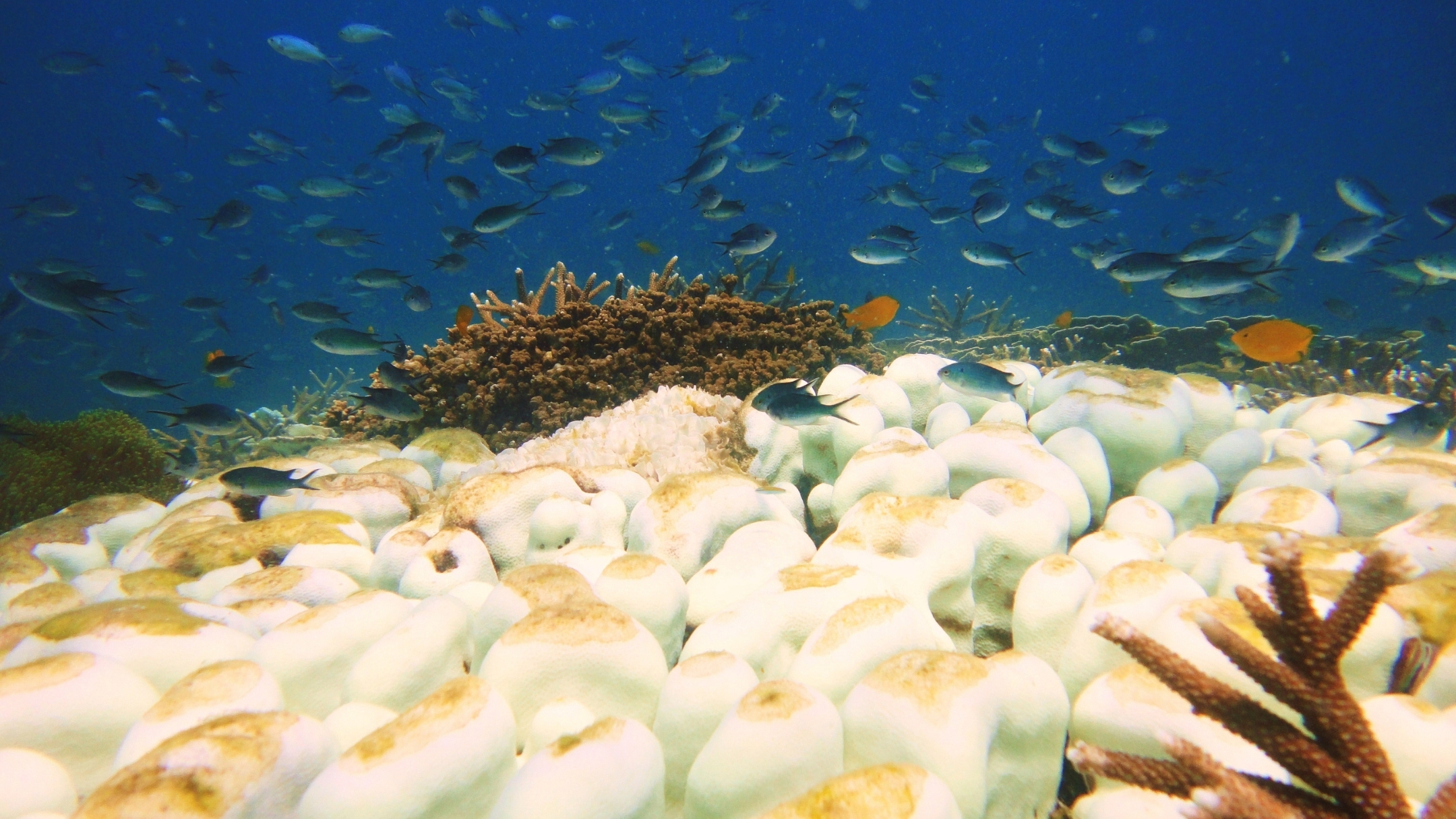
Palau has a long history of managing reef fisheries, beginning with the traditional Bul system and expanding to formal government regulations starting in the 1970s. Management measures have included fishing bans, size restrictions, marine protected areas, state fisheries plans, and a nationwide reef fish export ban introduced in 2020 to help conserve marine resources. While the export ban is expected to reduce fishing pressure on reefs, recent discussions about allowing limited non-commercial exports by Palauan citizens could pose challenges to the long-term sustainability of fisheries and reef ecosystems. To provide data-based evidence to support informed decision-making, this study presents a framework to assess the status of reef fishery species using methods for data-poor datasets.
The authors assessed 45 key reef fishery species in Palau by compiling fish landing data spanning nearly five decades: contemporary length-frequency data (2014–2024) collected via stereo-video camera surveys at Koror’s main fish market, and historical catch/length data (1976–1992) from multiple agencies, used to track shifts in species composition over time. For each species, life-history parameters (asymptotic length, size at maturity, natural mortality-to-growth ratio) were compiled from local studies where available, or otherwise estimated from synthesized regional databases or generic empirical equations, generating 32 plausible parameter scenarios per species to capture uncertainty alongside a prioritized “best estimate.” Stock status was assessed primarily using the Length-Based Spawning Potential Ratio (LBSPR) method, cross-checked against two alternative data-limited approaches (Length-Based Bayesian Biomass and the Stock Assessment Continuum Tool), and species were classified into four traffic-light categories (Sustainable, Depleting, Vulnerable, Depleted) based on standard reference points for spawning potential ratio and relative fishing mortality (F/M).
The 32 scenarios conducted using alternative length-based assessments and life-history parameters indicated that 97% of key reef fishery species assessed from market landings in Koror State, Palau, could be depleted, vulnerable, or at risk of depletion.
|
24.4% Depleted (SPR <20%) |
51.1% Vulnerable (SPR 20–40%) |
17.8% Depleting (SPR >40%, F/M≥1) |
6.7% Sustainable |
A precautionary re-analysis (using worst-case confidence limits) found zero species qualifying as sustainable. Results were consistent across all three independent assessment methods.
When looking specifically at which species fit in these categories, authors found:
- Large-bodied, slow-growing species are hit the hardest: SPR declines significantly with maximum length, asymptotic length, and size at maturity. Groupers (Serranidae), snappers (Lutjanidae), and sweetlips (Haemulidae) have the highest proportion of depleted stocks; large excavator parrotfish were universally depleted.
- Fishing pressure has shifted, not eased: Historically dominant species (bumphead parrotfish, camouflage/brown-marbled grouper, mottled spinefoot) have declined in landings, replaced by other parrotfish and surgeonfish (e.g., Pacific longnose parrotfish, orangespine unicornfish). This is a classic “fishing down/across” pattern rather than recovery.
- Spawning aggregation species remain vulnerable: Despite seasonal closures and two protected aggregation sites, key grouper species (camouflage grouper, squaretail & leopard coralgrouper) are still Depleted/Vulnerable, and longnose emperor aggregates on a different lunar cycle than assumed in current draft management plans.
- Even “traditionally minor” species are now under pressure: Small-bodied grazers, browsers, and planktivores are contributing a growing share of landings, indicating fishing effort is diversifying into species not previously monitored or managed.
Management Implications for Palau
- These findings highlight a need for improved management to protect depleting fish stocks, and the authors caution against the potential lifting of the reef fish export ban.
- Recommended management actions include fishing bans in spawning aggregation areas, seasonal fishing bans, better species-specific management, and nationally recognized minimum size catch limits.
Management Implications
- Small-scale fisheries with data-poor stock assessments can use this framework to capture realistic levels of uncertainty of future stock levels. Collecting data on life history characteristics including spawning seasons and aggregation areas, demographics, migratory patterns, and biological information is important for effectively managing fisheries.
- Comparing historical and contemporary data can provide important information about shifts in species-specific stock trends. Temporal changes in catch sizes and species may be an indication of what is happening to fish stocks.
- Policy amendments and implementations need to consider biological, historic, and contemporary stock trends, and life history data to ensure decisions are informed and fisheries are sustainable.
Author: Muller Karanassos, C., A. Marshell, B. Wolfe, S. Lindfield, J. Prince, N. C. Krueck
Year: 2026
Rev Fish Biol Fisheries 36: 54. doi: https://doi.org/10.1007/s11160-026-10054-3