Value of Reefs

Coral reefs are some of the most valuable ecosystems on the planet. While they cover only about 0.1% of the ocean floor, they are home to at least a quarter of all marine species.
The value of coral reefs extends well beyond their biological diversity, as they provide countless goods and services to the coastal communities that depend on them. Examples of these services include fisheries, tourism and recreation, shoreline protection, social connection, cultural belonging, and sources of medicinal compounds. ref
Effectively communicating the value of reefs to stakeholders is critical to foster stewardship and encourage conservation and management actions. Explore below for information and talking points on the value of reefs.
Coral Reef Facts
- Coral reefs are living structures that support a phenomenal diversity of species, including over 4,000 species of fish and 800 species of corals. ref
- Healthy coral reefs provide sources of sustainable food, livelihoods and income generation, and protection from storm surge. In many places, local communities also have a strong spiritual connection to coral reefs. ref
- Over one billion people are directly dependent on reefs for their livelihoods. In Small Island Developing States (SIDS), about 94% of the population lives with 100 km of reefs. ref
- About 30% of all coral reefs in the world are found in the Coral Triangle of Southeast Asia. Coral reefs in the Pacific Islands account for about 26% of the world’s total reef area, while those in the Caribbean make up roughly 10%. ref
- Coral reefs are highly sensitive to warming temperatures associated with climate change. The IPCC predicts that an increase in ocean temperatures of 1.5°C could lead to the loss of 90% of coral reefs, and a 2025 report suggests that coral reefs may already have passed the tipping point of no return. ref However, evidence of local resilience gives hope of their survival with appropriate management at local scale. ref
- Repeated mass bleaching has been observed in some of the planet’s most iconic reef systems, including the Great Barrier Reef, the Caribbean, and the Red Sea. As of 2025, an estimated 87% of the world’s coral reefs have experienced bleaching level-stress at least once. ref However, bleaching does not automatically indicate mortality. While some reefs have bleached and recovered, others have shown surprising resilience.
Watch the International Coral Reef Initiative (ICRI) Ask the Expert Series - Corals and Local Communities:
Economic Value of Coral Reefs
Coral reefs have been valued as high as $9.9 trillion/year globally for the various goods and services they provide. ref Reef tourism alone is estimated to bring an annual revenue of $36 billion. ref However, these global economic valuations are imprecise and differ across regions and ecosystem services. For example:
- In Australia, the Great Barrier Reef is valued at a total of $95 billion, contributing $9 billion/year to the national economy and supporting 77,000 full time jobs. ref
- Coastal protection value: U.S. coral reefs annually provide flood protection to over 18,000 Americans and more than $1.8 billion annually in hazard risk reduction benefits. These services are particularly important for protecting underserved, underrepresented, and vulnerable populations. ref
- Tourism value: In Australia, reef associated tourism generates as much as $7.9 billion annually. ref In the Caribbean, total values for all reef-associated tourism (on-reef and reef-adjacent) are now estimated at over $7.9 billion with average values of 660 visitors and $473,000 per square kilometer of reef per year. ref
- Reef insurance: Parametric reef insurance policies are being bought against the risk of tropical storms to destroying coral reefs and their associated services. For example, the world's first reef insurance policy provided a payout of around $850,000 after Hurricane Delta in 2020 to fund restoration. ref These models are being replicated in the Mesoamerican reef, ref and Hawai‘i. ref
- Biodiversity credits are a market-based mechanism designed to incentivize the protection and restoration of natural environments. While the application of these credits to coral reef ecosystems is still under development to ensure standard methodologies and transparent reporting practices are in place, they may offer new mechanisms for coral reef conservation and restoration. ref
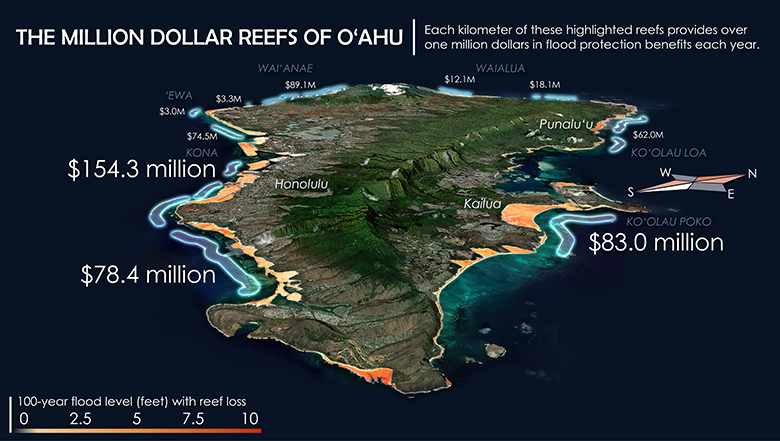
Value of reefs in O‘ahu, Hawai‘i based on models of flood protection benefits. Source: NOAA Coral Reef Conservation Program