Using MEAT to Monitor and Improve MPA Effectiveness at Mantalip Reef Marine Sanctuary
Location
Mantalip Reef Marine Sanctuary, Bindoy, Negros Oriental, Philippines
Summary
The Mantalip Reef Marine Sanctuary in Bindoy, Negros Oriental, is situated within the Tañon Strait Protected Seascape, one of the Philippines’ most significant marine corridors. Once degraded by overfishing, blast fishing, and cyanide fishing, the sanctuary has been transformed into a nationally recognized model for locally managed marine conservation. Central to this achievement is the consistent application of the MPA Management Effectiveness Assessment Tool (MEAT), which enables managers and community stakeholders to track progress, identify gaps, and adapt strategies over time.
The Challenge
Since 2017, regular MEAT assessments have driven improvements in enforcement infrastructure, community participation, and ecological monitoring. The sanctuary has earned multiple national awards for outstanding management. Ongoing challenges such as typhoon impacts on coral cover and limited local capacity for biophysical monitoring underscore the need for continued climate resilience planning, capacity building, and adaptive management. The Mantalip experience demonstrates that science-based, community-driven conservation, supported by structured assessment tools, can deliver lasting results for coral reef ecosystems and the communities that depend on them.
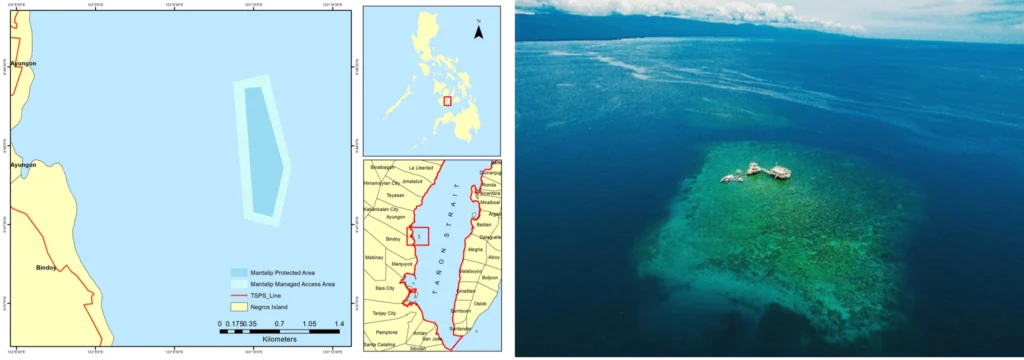
Location of Mantalip Reef Marine Sanctuary, Bindoy, Negros Oriental, Philippines. Photo © Municipality of Bindoy, Negros Oriental.
Mantalip Reef is located within the Tañon Strait, a major marine corridor separating the islands of Negros and Cebu in the central Philippines. Declared a Protected Seascape under Presidential Proclamation No. 1234, the Tañon Strait is one of the country’s largest protected marine areas. Within this broader seascape, Mantalip Reef Marine Sanctuary serves as a core no-take zone, providing critical habitat for coral reef species and serving as a source of larval replenishment for surrounding fishing grounds.
The sanctuary encompasses 46 hectares, making it the largest managed marine area in the municipality, and is one of six marine protected areas established across the coastal barangays of Bindoy. Its strategic position within the Tañon Strait means that effective management at Mantalip contributes not just to local fisheries, but to the ecological integrity of the entire protected seascape.
Before the Mantalip Reef Marine Sanctuary was formally established in 2001 and legally gazetted in 2008, the reef suffered from severe degradation. Overfishing, blast fishing, cyanide fishing, and habitat destruction had caused significant declines in coral cover, fish diversity, and overall biodiversity. Weak enforcement and limited management capacity meant that the area’s marine resources were in sharp decline, threatening both ecological health and the livelihoods of local fishing communities.
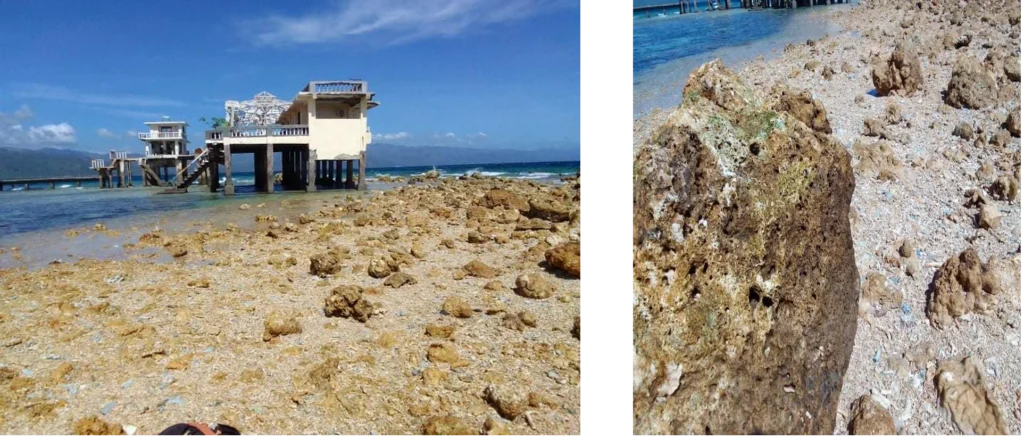
Damage caused by Typhoon Odette (Typhoon Rai) in 2021. Corals were destroyed and exposed due to shifting of sand and rubble. Photo © Municipality of Bindoy, Negros Oriental.
Establishing the MPA was a critical first step, but it was not sufficient on its own to demonstrate positive conservation outcomes. In 2011, the province of Negros Oriental adopted the MPA Management Effectiveness Assessment Tool (MEAT), developed in the Philippines through the Coral Triangle Support Partnership (CTSP). This gave the provincial Environment and Natural Resources Management Division (ENRMD) a structured way to provide technical support to local governments seeking to evaluate their MPAs. In 2017, the management body of Bindoy conducted its first MEAT assessment of Mantalip Reef as part of its application for a national MPA management award. This process revealed persistent gaps: community participation in law enforcement needed to be strengthened, and the MPA lacked local technical capacity for conducting biophysical monitoring, relying entirely on external partners for this function.
Actions Taken
Establishing and Expanding Marine Protection
The Local Government Unit (LGU) of Bindoy established marine protected areas across six coastal barangays. Mantalip Reef, at 46 hectares, is the largest of these sites. Complementary investments in guard houses, patrol boats, and coastal law enforcement infrastructure have strengthened on-the-water protection over time.
Monitoring Management Effectiveness with MEAT
The MPA MEAT tool evaluates reef health and management through standardized, participatory assessments. Every two years, stakeholders including fisher organizations, agriculture and environment officers, and local government representatives gather to score their MPA across six criteria:
- Biophysical condition, based on the most recent monitoring data
- Management body activity, including frequency and quality of meetings
- Legal and policy instruments in place
- Community participation in IEC campaigns, clean-ups, and patrolling
- Frequency and effectiveness of biophysical monitoring
- Site development, including infrastructure and habitat rehabilitation
Each criterion is scored on a four-level scale: Level 1 (Established), Level 2 (Strengthened), Level 3 (Sustained), and Level 4 (Institutionalized). The process is facilitated by the provincial ENRMD, which guides stakeholders through structured discussion and consensus scoring based on evidence from the most recent biophysical assessments and community records.
MEAT assessments have been conducted in 2017, 2022, and 2024. During the COVID-19 pandemic (2019 to 2021), community gatherings were not possible, so MEAT scoring was suspended, though biophysical monitoring by external partners continued.
Forging Multi-Sector Partnerships
Recognizing the limits of local technical capacity, Bindoy’s LGU has built a broad coalition of partners to support biophysical monitoring and management:
- Bureau of Fisheries and Aquatic Resources (BFAR)
- Department of Environment and Natural Resources (DENR)
- Philippine Coast Guard and Philippine Maritime Authority
- University of the Philippines Marine Science Institute (UP-MSI): biophysical monitoring support
- Rare Philippines: Fish Forever Project (social marketing and MEAT support)
- Blue Ventures: reef and fisheries management support
- Local divers’ associations
These partnerships have allowed the sanctuary to access the technical expertise needed for science-based management while building local ownership of results.
Social Marketing for Behavioral Change
Working with Rare Philippines, the LGU implemented a social marketing campaign grounded in Pride program methodology. This approach uses targeted communication to shift attitudes and behaviors among local fishers. Results have included increased voluntary reporting of illegal fishing activities, greater participation in mangrove rehabilitation, and stronger community ownership of MPA rules.
Local Government Budget Commitments
The LGU of Bindoy has institutionalized annual budget allocations to support MPA management, including:
- Coastal law enforcement activities
- Biophysical assessment and MEAT facilitation (conducted biennially)
- Ecotourism infrastructure development
- Reef and mangrove rehabilitation
- Capacity building for local managers and fisher organizations
How Successful Has It Been?
MEAT as a Driver of Adaptive Management
MEAT assessments have provided systematic, evidence-based insight into the sanctuary’s strengths and gaps. Results consistently show strong performance in enforcement and stakeholder engagement. By contrast, scores for monitoring and evaluation have highlighted the community’s dependence on external technical partners, prompting the management body to prioritize capacity-building efforts and formalize partnerships with UP-MSI and government agencies.
The 2022 and 2024 MEAT scores showed a lower rating for the Monitoring and Evaluation component compared to earlier assessments, reflecting both the disruption caused by the COVID-19 pandemic and the continued absence of a systematic data management system at the local level. This finding has driven renewed investment in local capacity and data governance.
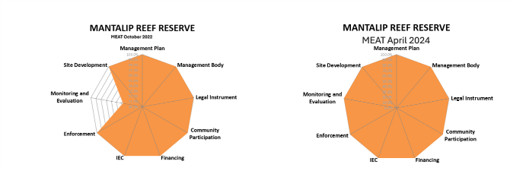
Diagrams comparing MEAT ratings for 2022 and 2024, showing the lower rating for M&E in 2022. Photo © Municipality of Bindoy, Negros Oriental.
Ecological Outcomes
Biophysical monitoring by UP-MSI documents a complex picture. Overall coral cover in the shallow areas of Mantalip Reef declined sharply following Typhoon Odette (2021), with monitoring in 2022 and 2024 confirming this trend. However, deeper reef areas that were less exposed to typhoon wave surge maintained fair to good coral cover, and fish abundance for key commercial species has increased since the sanctuary was established. These results demonstrate both the protective value of the MPA and the vulnerability of shallow reefs to climate-related disturbances.
Awards and Recognition
The MEAT tool has been used as the basis for several national MPA award competitions. Mantalip Reef’s results contributed directly to the following recognition:
| Year | Award |
|---|---|
| 2017 | Para el Mar Award: 3rd Place, Best Managed MPA in the Philippines |
| 2017 | Ocean Hero Award: Best Locally Managed MPA in the Philippines |
| 2018 | Galing Pook Award: Ridge to Reef Program |
| 2023 | Top 5 Finalist: Best Locally Managed MPA in the Philippines |
| 2024 | 2nd Best Performing LGU within the Tañon Strait Protected Seascape for Coastal and Fishery Law Enforcement |
Lessons Learned and Recommendations
Climate resilience must be built into MPA management plans. Typhoon Odette and El Niño events caused measurable harm to Mantalip’s coral reefs, underscoring that MPAs alone cannot protect against climate-driven disturbances. The LGU has expressed a need for technical assistance to implement science-based reef rehabilitation measures. Future management plans should explicitly address climate adaptation, including identifying and protecting thermal refugia, supporting natural recovery in deeper reef zones, and incorporating climate scenarios into long-term monitoring frameworks.
MEAT works best when paired with continuous capacity building. The tool requires that local managers can interpret biophysical data and translate it into management decisions. Currently, Bindoy’s LGU depends almost entirely on external partners (provincial government, national agencies, academic institutions, and NGOs) for data collection and analysis. Sustained investment in training local staff and fisher organization members to conduct monitoring and use MEAT results will be essential for long-term self-sufficiency.
A data management system is needed to support evidence-based decisions. Monitoring data currently exists mainly as hard copies provided by external partners, with no organized electronic system for tracking trends over time. Without accessible, centralized records, it is difficult for local managers to analyze change, prepare MEAT assessments, or report to funders and award bodies. Establishing a simple but robust data management system with templates, archives, and clear roles would significantly strengthen adaptive management.
Structured assessment tools promote transparency and stakeholder buy-in. By bringing fisher organizations, government officers, and community members together to score their own MPA, MEAT builds shared understanding and collective ownership of management priorities. The participatory scoring process, rather than a top-down assessment, is one of the tool’s greatest strengths. Managers in other locally managed marine areas should consider adopting MEAT or similar facilitated tools to drive community-led adaptive management.
Social marketing can shift conservation behavior at the community level. Rare’s Pride campaign methodology proved effective in changing attitudes among local fishers, shifting them from passive acceptance of MPA rules to active participation in enforcement and habitat restoration. Combining social marketing with governance tools like MEAT creates a powerful package for sustainable MPA management.
Funding Summary
- Local Government of Bindoy, Negros Oriental: Annual budget for MPA management, coastal law enforcement, ecotourism infrastructure, capacity building, reef and mangrove rehabilitation, and biennial MEAT facilitation
- Province of Negros Oriental (ENRMD): Technical support and facilitation for MEAT assessments and monitoring
- Rare Philippines: Fish Forever Project: Support for MPA establishment, social marketing strategy, and MEAT monitoring
- Blue Ventures: Reef and fisheries management support (blueventures.org)
Lead Organizations
- Local Government of Bindoy, Negros Oriental
- Environment and Natural Resources Management Division (ENRMD), Provincial Government of Negros Oriental
Partners
- Bureau of Fisheries and Aquatic Resources (BFAR)
- Department of Environment and Natural Resources (DENR)
- Philippine Coast Guard / Philippine Maritime Authority
- University of the Philippines Marine Science Institute (UP-MSI)
- Rare Philippines
- Blue Ventures
- Local divers’ association, fisher organizations (Bindoy)
Resources
- Installation of Mooring Buoys at Mantalip Reef (video, 2025)
- Galing Pook Awards 2018: Ridge to Reef Program
- Ramos, Dino, Aragones, Lemuel & Rollon, Rene: Linking Integrity of Coastal Habitats and Fisheries Yield in the Mantalip Reef System
- Bindoy Municipal Government: Mantalip Reef Development Outlook
- Toolkit: MPA Management Effectiveness Assessment Tool (MEAT): Coral Triangle Initiative