
Climate-Smart Management Planning

Climate-Smart planning is the intentional and deliberate consideration of climate change in natural resource management, realized through adopting forward-looking goals and explicitly linking strategies to key climate impacts and vulnerabilities. ref
MPA planning and Climate-Smart planning are not separate processes; rather, Climate-Smart planning intentionally incorporates climate change considerations into each step of the management cycle. This approach ensures that every decision aligns with both current and future climate projections, resulting in a more resilient and effective management plan.
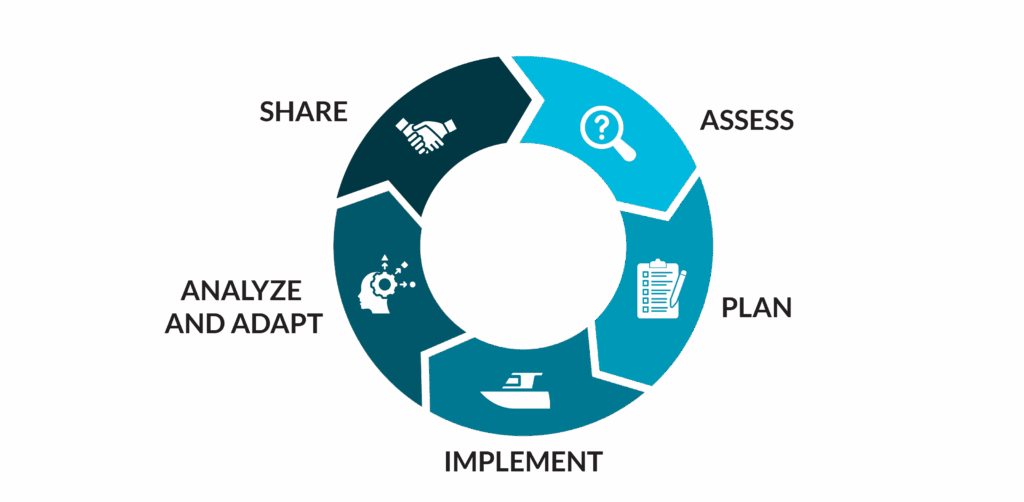
An MPA management planning cycle. Climate-Smart planning intentionally integrates climate-change in each of these steps.
Some of the most important attributes of Climate-Smart planning are: ref
- Act with intentionality: explicitly consider and address climate impacts (both direct and indirect) through actions.
- Manage for change, not just persistence: manage system transformations and focus on sustaining ecological functions, rather than historical assemblages of plants and animals.
- Reconsider goals, not just strategies: climate-informed reconsideration may not require a full revision, instead revealing the need to modify different components of a plan's conservation goals (e.g., what, why, where, or when some actions should be taken).
- Integrate adaptation into existing work: incorporate climate adaptation into ongoing programs, policies, and management actions rather than treating it as a separate initiative.
The same people who are responsible for management planning (e.g., planners, site managers, ecosystem specialists, and key stakeholders) should also be involved in Climate-Smart planning and be fully integrated into the core management planning process. It is important for all participants to develop a shared understanding of what climate change is, how it may affect conservation features, how it could influence planning and management decisions, and the types of challenges the Climate-Smart planning process will need to address.

Bahamas National Trust staff incorporate Climate-Smart updates in a marine protected area management plan. Photo © The Nature Conservancy
Climate-Smart planning helps balance immediate management needs with preparation for long-term ecological change, supporting the development of adaptive and resilient strategies. For example, in Puerto Rico, reef ecosystems around Culebra are threatened by land-based runoff from unpaved roads. Climate change impacts, including sea-level rise and increased sea surface temperatures, exacerbate erosion, amplifying the negative effects of poor water quality on reefs. To increase reef resilience (and with the support of NOAA’s Coral Reef Conservation Program), 15 miles of roads have been stabilized, and local staff have been trained to maintain them. As a result, 51 metric tons of sediment are no longer reaching the nearshore reefs each year, improving water quality and strengthening the resilience of the reef ecosystem.
To better understand how to apply Climate-Smart planning principles to MPA management, the next few pages of this toolkit provide a framework that highlights key steps including:
- Understanding climate change trends and potential impacts
- Identifying and prioritizing what will be most affected
- Developing Climate-Smart actions to address these impacts
This framework was developed to provide a structured approach for adapting MPA management plans to be Climate-Smart and is based on numerous climate adaptation planning resources. ref While this toolkit highlights only the key elements of the framework and steps, the Guide and supplementary materials provide a more detailed description.
Climate-Smart Management Planning in The Bahamas
Read the Climate-Smart Management Planning in the Bahamas Case Study to learn more about the piloting of this framework.Watch the following webinar recording to learn more about the project in The Bahamas:
Listen to the following podcast episode to hear a short conversation about the project:
The Climate Adaptation Toolkit was developed in partnership with the Blue Nature Alliance, a global partnership to catalyze effective large-scale ocean conservation. Additional insights and resources were provided by our friends at Conservation International, and the National Oceanographic and Atmospheric Administration (NOAA) MPA Center.