
Management Approach and Climate-Smart Goals

Once an MPA’s key conservation features, as well as the main threats they are facing, have been identified, the next step is to review the management approach and create Climate-Smart goals to adapt into management. This process requires an assessment of what futures are feasible, desirable, and achievable for the conservation features, given the projected impacts.
Review the Management Approach
Climate change threats will continue to impact marine ecosystems and cause inevitable changes to the conservation features that managers are working to protect. With this understanding, revisiting the management approach is critical to ensure that efforts are not wasted on unrealistic expectations.
The Resist–Accept–Direct (RAD) Framework ref offers a structured way to think about management approaches in the face of climate change:
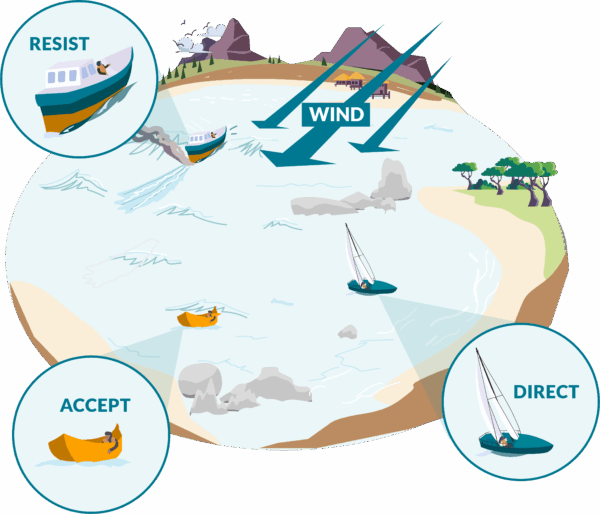
The RAD framework—Resist, Accept, Direct—illustrated. 'Resist' aims to maintain current conditions despite external pressures, 'Accept' allows changes to unfold with minimal intervention, and 'Direct' involves steering systems toward a desired future state. Source: Adapted from Schuurman et al. 2022
For example, under climate change, mangroves will experience sea-level rise, saltwater intrusion, and community shifts or loss of trees. Using the RAD Framework, managers can consider:
- Conservation strategy: Should restoration be prioritized where mangroves are dying due to saltwater intrusion?
- Use of funds: Should resources shift toward protecting mangroves in less vulnerable areas?
- Communication with stakeholders: How should the potential loss of mangroves and associated fisheries be discussed with stakeholders?
Despite the various questions that can be raised under the RAD framework, there is no single "right" answer. Reframing the management approach, whether to resist changes, accept inevitable shifts, guide ecological transitions, or some combination of these options, enables the most effective strategies in the face of persistent threats.
The RAD decision tree can help prompt key management questions and guide decision-making early in the planning process:

Decision tree showing the three possible management responses to the trajectory of change under the Resist-Accept-Direct (RAD) framework. Source: Schuurman et al. 2020
Define Climate-Smart Goals
Climate-Smart goals describe the desired future condition of a conservation feature in the face of climate change. These goals often extend well beyond the typical time frame of a management plan (20, 50, or even 100 years). Managers may need to consider sequential goals based on their management approach, where goals shift once a threshold is met. For example, managers may decide to resist the loss of live coral cover until it reaches less than 5% and then accept those losses.
Key considerations when setting Climate-Smart goals:
-
- Goals should reflect known climate change trends and align with the chosen management approach (Resist, Accept, Direct)
- Goals should represent what management ultimately aims to achieve despite changing conditions
- Goals should avoid overcommitment to "saving" or "maintaining" current conditions if the threat analysis indicates that change is inevitable
The Climate Adaptation Toolkit was developed in partnership with the Blue Nature Alliance, a global partnership to catalyze effective large-scale ocean conservation. Additional insights and resources were provided by our friends at Conservation International, and the National Oceanographic and Atmospheric Administration (NOAA) MPA Center.