
Impacts of Climate Change on MPAs

Climate change is reshaping marine ecosystems and coastal communities worldwide. From shifting species distributions to ocean acidification, coral reef degradation, and rising sea levels, the impacts of climate change are persistent, compounding, and here to stay. ref Unlike short-term disturbances, climate change introduces chronic, long-term stressors that can undermine the effectiveness of even the most well-managed MPAs. Climate impacts can also exacerbate existing non-climate stressors (e.g., sedimentation and habitat loss).
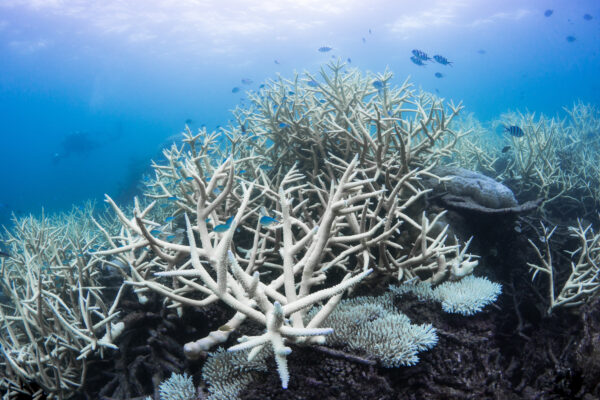
Coral bleaching on the Great Barrier Reef, Australia. Photo © The Ocean Agency/Ocean Image Bank
Climate change impacts are fundamentally different from other threats due to their scale, pace, and unpredictability. Traditional threats such as unsustainable fishing, pollution, and habitat destruction are often more localized and, in some cases, reversible. By contrast, climate change is global in nature and cannot be mitigated without strong actions at global, national, and local scales to reduce CO2 emissions.
Climate change also intensifies many existing threats. ref For example, there is substantial evidence linking sewage pollution to increased coral bleaching, particularly during periods of elevated sea surface temperatures (SSTs). Nutrient-rich wastewater, often containing high levels of nitrogen and phosphorus, can exacerbate the stress corals experience from thermal anomalies. This combination can lead to more frequent and severe bleaching events. ref
Traditional management has focused on data-driven certainty: working toward predictable outcomes and restoring ecosystems to a stable, historical state. The magnitude and uncertainty of climate change impacts, however, make such stability increasingly unrealistic. Particularly in MPAs, the conditions managers are familiar with and operate in are shifting, and predictions are becoming more difficult to make. Approaches that once relied on stability and long-term predictability must now become more flexible, responsive, and forward-looking.
Meeting this challenge will require a fundamental shift in MPA management. Embracing adaptive strategies that account for uncertainty is not just a better practice, but a necessary step toward sustaining the biodiversity, ecosystem services, and cultural values that MPAs are intended to protect.Watch the video to learn more about managing MPAs for climate change:
The Climate Adaptation Toolkit was developed in partnership with the Blue Nature Alliance, a global partnership to catalyze effective large-scale ocean conservation. Additional insights and resources were provided by our friends at Conservation International, and the National Oceanographic and Atmospheric Administration (NOAA) MPA Center.