
Conservation Features and Threats

Understanding how climate change intersects with key conservation features and associated threats is essential for effective, forward-looking marine protection. The steps below provide a practical framework for identifying relevant climate projections, defining conservation priorities, and assessing risks to support Climate-Smart planning.
Define Climate Change Projections and Trends
The process begins by identifying the best available climate change predictions for the geographic area of interest. If localized data are not available, look for regional data that are relevant (see Resources section). For example, The Bahamas does not have national climate predictions for all climate threats but instead rely on models that cover the wider Caribbean basin.
Managers will likely refer to trends such as increasing sea surface temperatures and sea-level rise. Climate projections, such as the number of inches the sea level will rise by 2050, typically carry greater uncertainty.
Review or Define Key Conservation Features
The first stage of assessing climate change impacts is to identify priority conservation features that the analysis will focus on. Key conservation features, such as habitats, endangered species, and ecosystem services, are the elements that MPAs aim to protect to maintain socio-ecological functionality into the future and may already be defined in management plans.
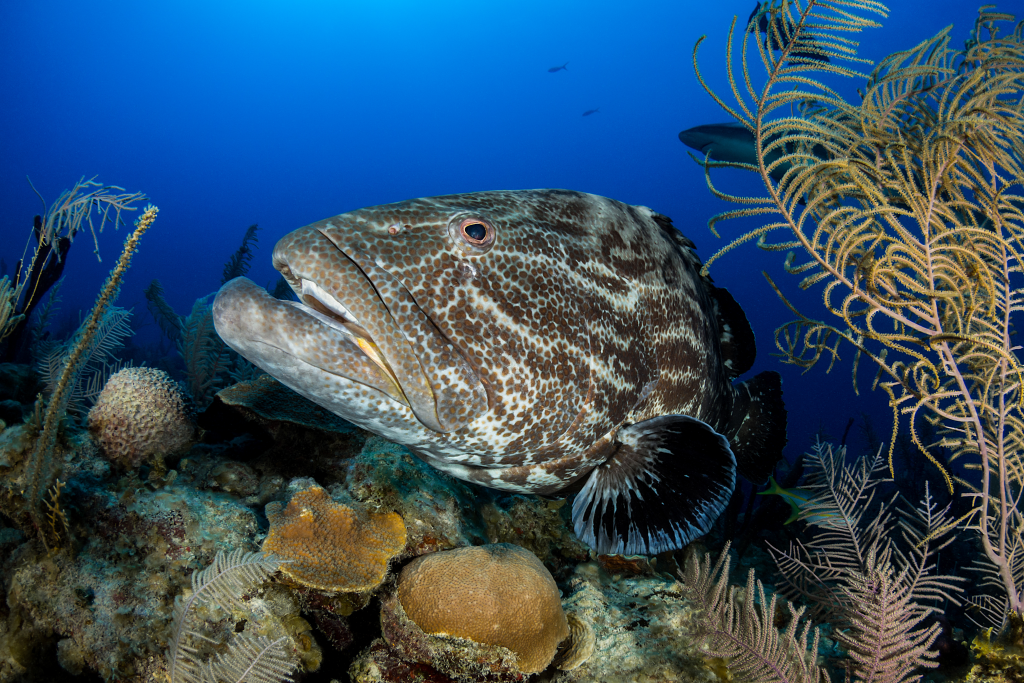
Endangered species such as the goliath grouper are protected in the Gladden Spit and Silk Cayes Marine Reserve, Belize. Photo © Fabrice Dudenhofer/Ocean Image Bank
Define Threats (Vulnerability Assessment)
This step involves two key tasks:
- List both climate and non-climate threats to the MPA
- Identify how these climate and non-climate threats could impact priority conservation features
Common climate threats include:
- Sea-level rise
- Ocean acidification
- Increasing ocean and air temperatures
- Changes in extreme events and precipitation patterns (e.g., storms, floods, heatwaves)
This step requires some understanding of the present and future impacts of the climate projections on the key conservation features. It can be useful to consult with experts that have been tracking existing impacts or have studies of these impacts in other regions.
Prioritize Threats (Vulnerability Assessment)
Prioritizing threats is one of the most critical steps in the Climate-Smart planning process. It ensures that actions focus on the most significant risks to conservation features, rather than simply on threats that are easier to address.
Threats can be prioritized using three criteria: ref
The proportion of the conservation feature likely affected by the threat by 2050, based on current trends. For ecosystems and communities, scope refers to the affected geographic area. For species, scope refers to the proportion of the population likely to be impacted.
Within the given scope, the expected level of damage to the conservation feature from ongoing threats. Measured as the degree of population decline for species and the degree of destruction or degradation for ecosystems and communities.
The degree to which impacts can be reversed or restored within a reasonable timeframe. Recoverability is also sometimes referred to as "irreversibility."
Climate-related threats often rank highly in a vulnerability assessment because they typically have a broad scope and low recoverability, meaning their impacts are widespread and difficult to reverse.
Watch the video below about the islands of Lau in Fiji to learn more about vulnerability assessments for climate change:
The Climate Adaptation Toolkit was developed in partnership with the Blue Nature Alliance, a global partnership to catalyze effective large-scale ocean conservation. Additional insights and resources were provided by our friends at Conservation International, and the National Oceanographic and Atmospheric Administration (NOAA) MPA Center.

Resources
NOAA Vulnerability Guide for MPAs
The Climate Change Resilience and Adaptation Planning Tool
Video: Vulnerability Assessment in the Islands of Lau
Copernicus Climate Data Store (CDS)
Climate Research Unit Time Series
Berkeley Earth Surface Temperature (BEST)
Global Surface Summary of the Day (GSOD)
Global Historical Climatology Network (GHCN)