
Coral Propagation

The focus of most reef restoration projects to date has been to re-establish coral cover on degraded reefs by transplanting corals propagated through an intermediate nursery stage. Transplants can be produced through coral gardening (or asexual propagation), which involves fragmenting donor corals to grow new colonies. They can also be produced through larval propagation (or sexual propagation), which uses collected coral spawn to rear larvae into mature colonies.

The process of coral gardening for restoration. Production of this infographic was funded through the Australian Government’s National Environmental Science Program Tropical Water Quality Hub
Larval propagation harnesses the corals’ natural sexual reproduction cycle and is increasingly used to scale up coral reef restoration and increase diversity. One of the main benefits of larval propagation is to increase the genetic diversity of corals on reefs, allowing them to adapt more quickly to changing environmental conditions.
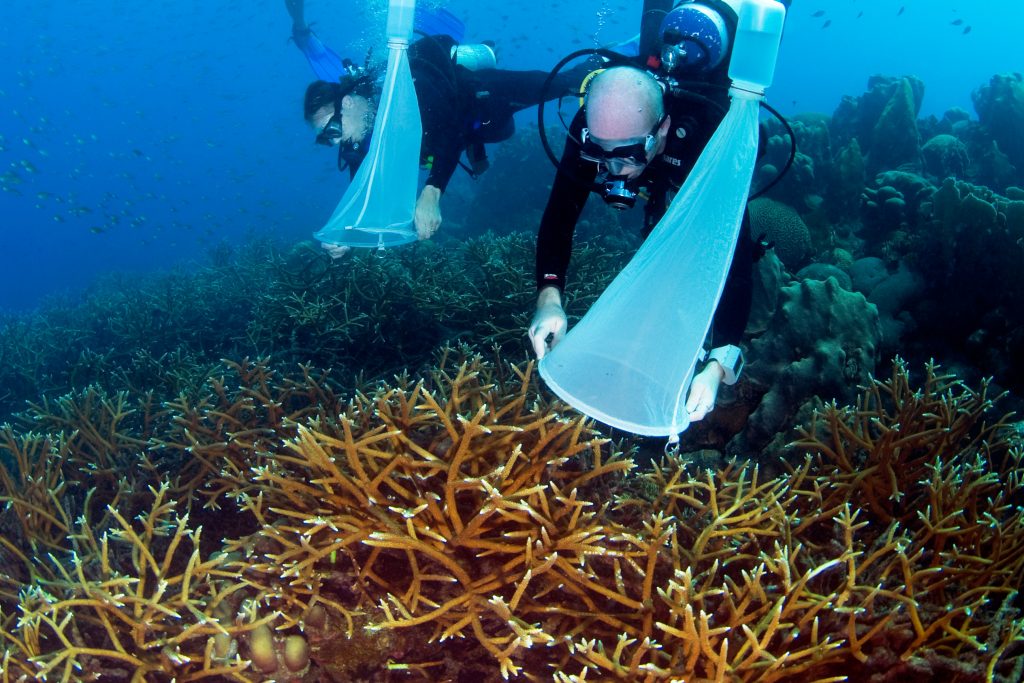
Collecting coral gametes from Acropora corals. Photo © Barry Brown/SECORE International
Field- and Land-Based Nurseries
Coral nurseries may be field-based (“in situ”) or land-based (“ex situ”). Both types can produce large numbers of coral colonies, but each comes with unique advantages and limitations that depend on the specific goals and resources of the restoration program.
Field-based Nurseries:
- Relatively low-cost and low-technology methods
- Maintenance is more easily performed by less skilled or experienced personnel
- More susceptible to environmental extremes like warm temperatures or strong storms
Land-based Nurseries:
- Sheltered from bleaching events, biological pests, and disease
- Environmental conditions can be manipulated to promote optimal coral survivorship and growth year-round
- Most suitable for larval-based restoration and micro-fragmentation
- High building and maintenance costs
- Maintenance requires experienced staff trained in aquarium husbandry
Outplanting
Outplanting is the phase of coral restoration in which corals are secured back onto the reef habitat. Outplanting can be the most expensive and labor-intensive part of coral restoration efforts due to long hours and many people needed using SCUBA and boats. Therefore, this phase should be undertaken with thoughtful planning to minimize the loss of nursery-reared corals.
Examples of considerations to maximize outplanting success include careful site selection, transport that minimizes stress to the outplants, adequate health and size of coral outplants, outplant density and arrangement, and genetic considerations.
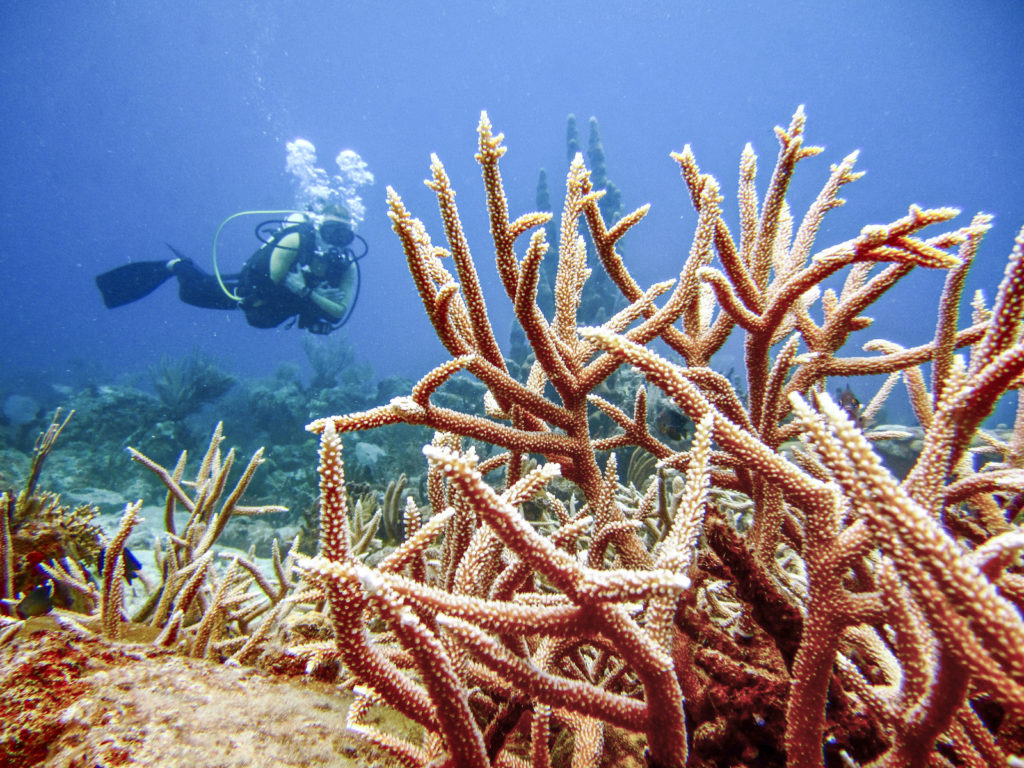
A diver approaches outplanted staghorn coral. Photo © Kemit-Amon Lewis/The Nature Conservancy
See the Coral Reef Restoration Online Course Lesson 2: Coral Propagation and Field-Based Nurseries for more information on the types of field-based nurseries and outplanting considerations to maximize restoration success, Lesson 3: Land-Based Coral Nurseries for more information on coral husbandry in land-based systems, and Lesson 4: Larval-Based Coral Propagation for more information on the steps involved in sexual coral propagation from collecting gametes to outplanting and monitoring coral recruits.