
Coral Reef Restoration Monitoring

Tracking and evaluating progress is a critical component of any restoration project. Regular monitoring helps determine whether project objectives are being met, assess the effectiveness of specific approaches, and identify areas for improvement. Monitoring also provides measurable results that can be communicated to stakeholders, ensures transparency throughout the process, and is often a requirement for permitting.
The Coral Reef Restoration Monitoring Guide
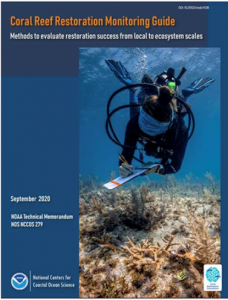 The Coral Restoration Consortium (CRC) Monitoring Working Group recently developed the Coral Reef Restoration Monitoring Guide to provide comprehensive guidance for monitoring coral reef restoration efforts and evaluate progress towards restoration goals.
The success of restoration ultimately depends on restoration goals and may therefore look different for each restoration project. As a result, metrics of success can be specific to coral colonies, related to broad coral reef function or even refer to socioeconomic parameters. There is no “one-size fits all” approach to defining and monitoring the success of coral reef restoration efforts. However, the lack of standardized approaches and metrics for monitoring has impeded the capacity to compare success across different programs and accurately inform the field of coral reef restoration.
To address that issue, the CRC Coral Reef Restoration Monitoring Guide presents two broad categories of metrics: ref
- The Universal Metrics which are suggested as the minimum set of metrics that should be monitored by all restoration projects, regardless of the project’s goal(s) or objectives.
- The Goal-Based Metrics which can be tailored to a specific goal.
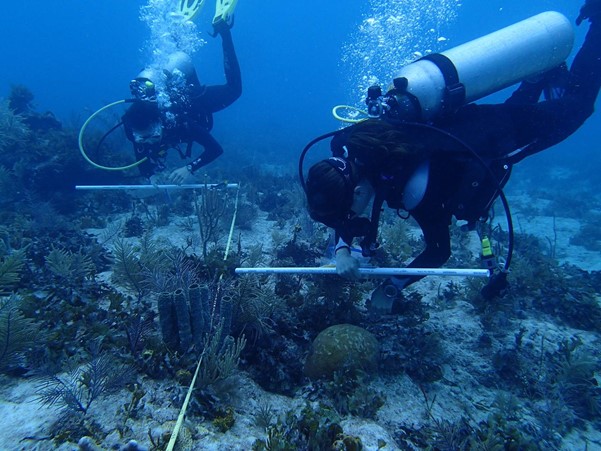
Using 2-meter belt transects to monitor a reef in the Florida Keys, USA. Photo © Elizabeth Shaver
Beyond the choice of appropriate metrics, developing a monitoring plan for coral reef restoration also involves:
- Defining baseline data, control, and reference sites
- Choosing an appropriate sampling design (e.g., random versus fixed)
- Carefully considering monitoring timeframes as metrics and sampling design will evolve
Monitoring Methods
Methods for monitoring coral reef restoration efforts are adapted from traditional reef survey methods. Typically, these include:
- Colony-based data (e.g., in-situ tracing, mosaics, genetic sampling, coral fate-tracking)
- Environmental data (e.g., in-situ loggers, open access data sources, dive computer/thermometer)
- Ecological data (e.g., transects, quadrats, roving diver surveys)
- Socio-economic data (e.g., online surveys, in-person interviews)
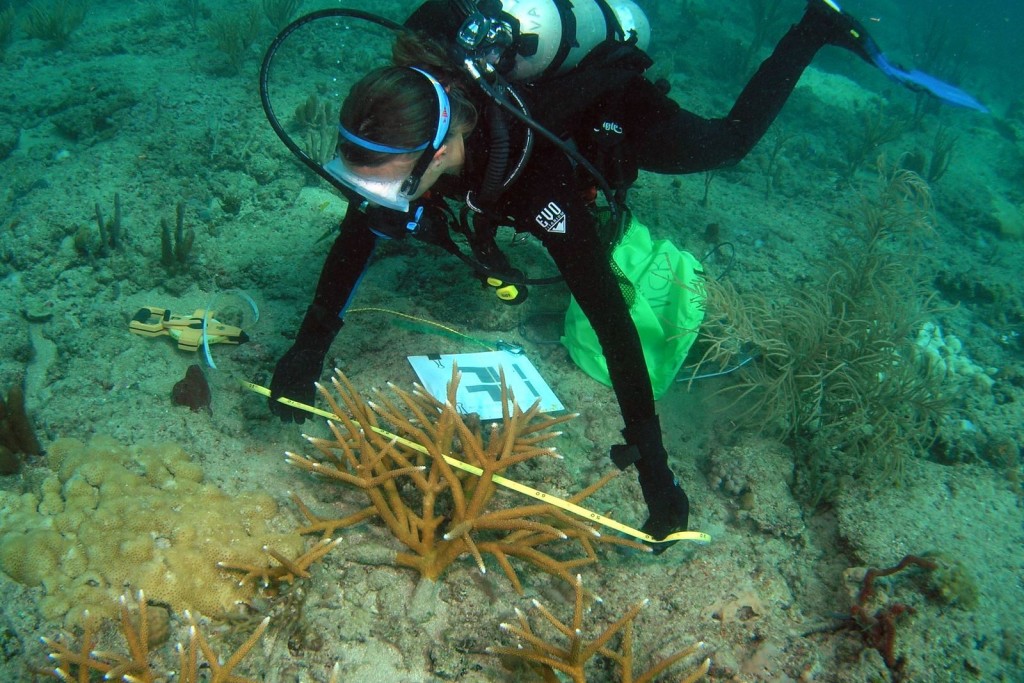
Diver measuring the diameter of a coral colony. Photo © NSU CRRAM Lab
See the Coral Reef Restoration Online Course Lesson 7: Monitoring for Coral Reef Restoration for more information on current practices in monitoring for coral reef restoration and recommendations for standard monitoring metrics that can be used to help compare across projects.