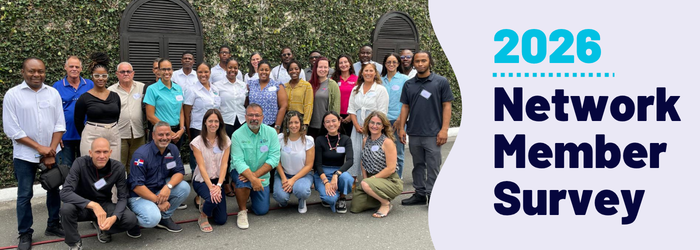
Developing an Integrated Coral Disturbance Response Plan – Guam, 2026
RRN hosted a workshop to pilot a new Integrated Coral Disturbance Response Planning Framework

RRN hosted a workshop to pilot a new Integrated Coral Disturbance Response Planning Framework
View the recording and resources to learn more about climate-smart reef management.
In January 2026, nine NGO staff from the CoralCarib Project—spanning the Dominican Republic, Haiti, the U.S. Virgin Islands, Jamaica, and Cuba—joined a virtual presentation about the ongoing Super Reefs work in Belize.
Climate change is likely to enhance macro-algal growth and reduce fish size, making the role of invertebrate grazers even more critical. Strategies should combine ecological understanding with climate action, prioritize protection of wild populations, and use adaptive, site-specific approaches.
Marine managers and practitioners from Cuba, the Dominican Republic, Haiti, Jamaica, and the US Virgin Islands participated in the Caribbean PAME Workshop, which focused on using PAME assessments and monitoring data to evaluate progress toward site outcomes, and more.
This study reports the detection of a new invasive soft coral species in Puerto Rico: Latissimia ningalooensis, originally native to Australia. First observed in March 2024, this is the second invasive soft coral species reported in Puerto Rico in under six months, following Xenia umbellata in October 2023.
Climate-Smart Management Planning in The Bahamas
Managers face significant challenges in combating SCTLD due to the limited understanding of its cause, transmission mechanisms, and effective treatments. This review synthesizes current knowledge to help guide efforts in mitigating the impacts of this disease.
The Network piloted the new MPA Enforcement Online Toolkit with a group of 21 marine managers and enforcement officers from large-scale marine protected areas (LSMPAs) across the Latin America region at an in-person, week-long learning exchange in San Andres, Colombia. Attendees read the online toolkit as a prerequisite for the in-person workshop, learning foundational concepts for monitoring, control, surveillance, and enforcement (MCS&E) systems.
The Network provided training to 25 marine managers, planners, and other staff from the Hawai’i Division of Aquatic Resources. The participants, representing five islands, learned about strategic communication and strategized how to engage Hawai’i residents in the new community-centered engagement process to shape and inform the management of marine resources through the Holomua Marine Initiative.
This two-day workshop focused on helping partners in The Bahamas understand climate change threats and impacts, and introducing them to the climate-smart management planning process. The workshop provided participants with an understanding of The Nature Conservancy (TNC) Reef Resilience Network’s (RRN) climate-smart planning guide, practical methods for integrating climate considerations into management strategies, and hands-on experience with climate-smart planning tools.
The Marine Action Partnership (MAP) – A Collaborative Approach to Improve Sustainable Fishing in The Bahamas
In October 2024, 17 marine managers, planners, and administrators from the Bahamas National Trust participated in the Climate Smart Management Planning Moriah Harbour Cay National Park and Lucayan National Park Workshop to focus on completing climate-smart updates to the park management plans. Participants identified key climate change and non-climate threats and impacts that affect priority conservation features in these parks.
10 marine managers, planners, and administrators from the Bahamas National Trust participated in the Climate-Smart Management Planning Exuma Cays Land and Sea Park Workshop in Nassau, Bahamas. This 3-day workshop focused on completing climate-smart updates to the Park’s management plan.
In July 2024, The Nature Conservancy in Africa hosted Reef Restoration Initiatives in the Western Indian Ocean for Lesson Sharing, Capacity-building and Networking, a three-day regional workshop on Unguja Island, Zanzibar.
The Reef Resilience Network and The Nature Conservancy in Africa are working together to scale-up effective coral reef restoration activities in the Western Indian Ocean by building knowledge and skills of the marine managers and practitioners leading this work.
RRN provided support to 12 marine managers, planners, and conservation practitioners from the Bahamas National Trust to begin incorporating climate-smart and resilience principles into national park management plans.
Ongoing series of online activities and events to discuss and demystify the issue of ocean wastewater pollution and innovative approaches being used to address it.
Collaborative Efforts to Address Wastewater Pollution and Safe Drinking Water Concerns in the USVI